AI estimate as of July 22, 2026 · verify with a professional before acting
AI-Generated · Verify before acting
Everything on this page is generated by AI for informational purposes only. AI can make mistakes — the AI may misidentify items or misattribute them (artist, maker, brand, designer, origin, era). This is not an official valuation and should not be used for insurance, sale, tax, estate, legal, or lending purposes — or any decision requiring a certified appraisal. It is not an authoritative claim about any person, brand, or rights holder — do not share or rely on it as a factual statement about a third party. Always consult qualified professionals before making financial decisions.
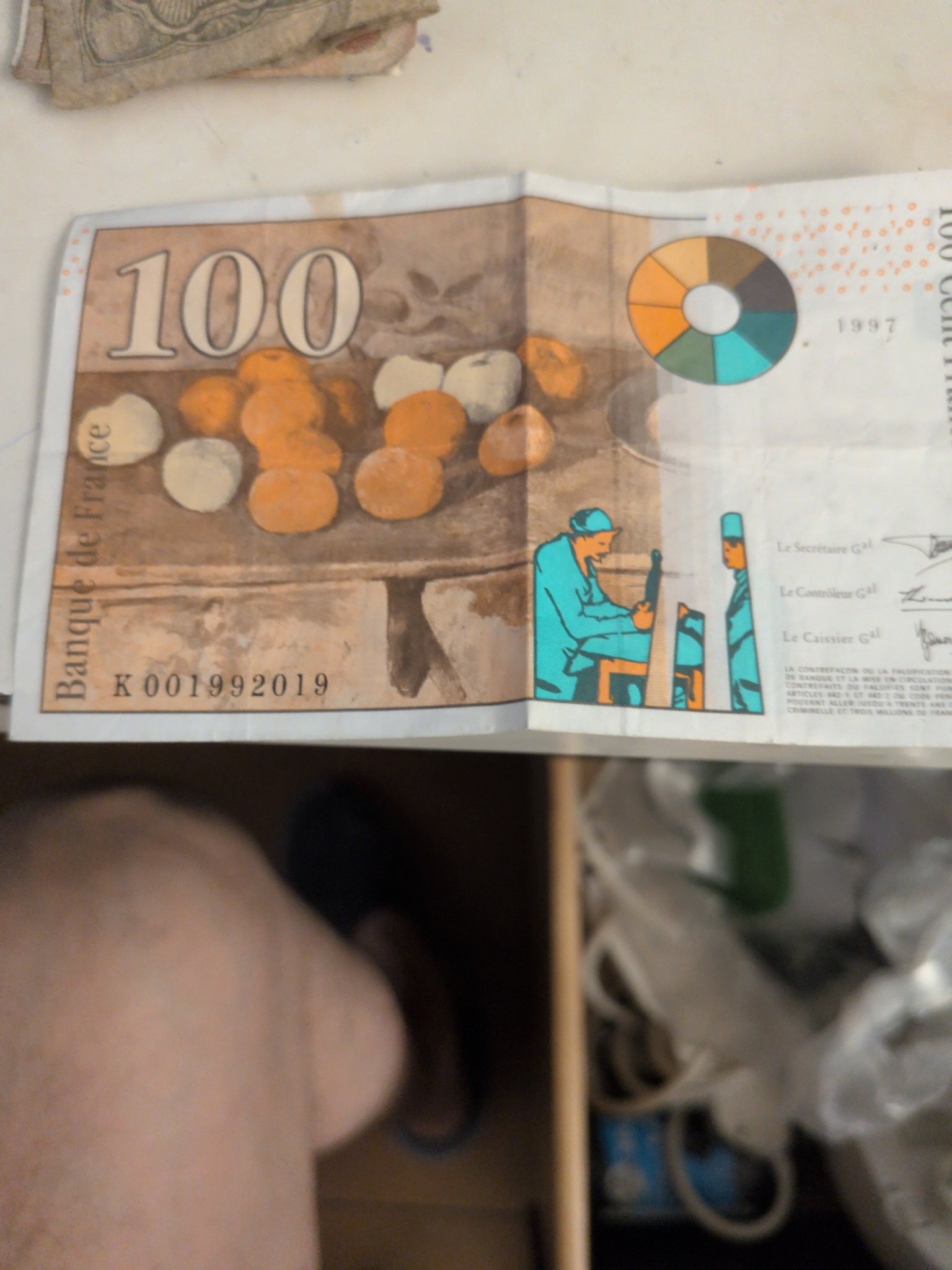
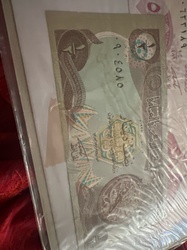
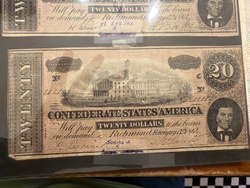
This item appears to be a French paper banknote denomination of 100 Francs, printed with the year '1997'. The bill features imagery associated with the Post-Impressionist painter Paul Cézanne, including a still life depicting apples and oranges across the center, a color wheel graphic in the upper right, and stylized figures at the lower right. Visible text includes 'Banque de France' along the left edge, the serial number 'K 001992019', the date mark '1997', and titles for signatures including 'Le Secrétaire Gal', 'Le Contrôleur Gal', and 'Le Caissier Gal'. A legal warning regarding counterfeiting is visible in tiny text at the bottom right corner. The note displays noticeable horizontal and vertical fold creases, handling wear, and minor rumpling along the edges, typical of circulated currency. Printed paper currency of this type is consistent with the late 20th-century monetary issues of France prior to the adoption of the Euro, though physical examination by a specialist would be required to verify paper thickness, watermarks, and anti-counterfeiting features.
AI Appraisal Report
Based on what I can see in the provided image, this item appears to be a French 100 Francs banknote dated 1997, featuring Post-Impressionist painter Paul Cézanne. Based on visual details, it shows signature titles, a serial number (K 001992019), and characteristic artwork including a still life and color wheel. However, I cannot verify from a photo the paper weight, texture, watermarks, microprinting, or UV-reactive security elements. A physical inspection by a currency specialist would be necessary to evaluate these physical security features.
The value estimate assumes this note is a standard, issued French banknote from the pre-Euro era. Notes of this series were widely circulated prior to France's transition to the Euro. Condition is a major factor in paper money valuation; this example displays visible vertical and horizontal folding, edge wear, and handling marks consistent with a circulated grade (typically Very Fine to Extra Fine). Uncirculated examples command higher premiums, whereas circulated notes generally remain in the modest collector price bracket.
Collector demand for modern European pre-Euro national currencies is steady, though mostly limited to general numismatic interest rather than high-value rarity, unless bearing specific rare serial numbers, replacement prefixes, or mint errors. Value depends on physical verification. If this piece were determined to be a modern reproduction, copy, or novelty print rather than an officially issued note, its commercial value would be negligible. To fully evaluate the item, an in-person examination to inspect paper fibers, watermarks, and security threads would be required.