These notes were written by the person who submitted this item. Appraiser.AI has not verified them, and the AI's identification and estimate may rely on them.
AI Estimated Value
Not an official valuation
$250-400
AI estimate as of October 12, 2025 · verify with a professional before acting
AI-Generated · Verify before acting
Everything on this page is generated by AI for informational purposes only. AI can make mistakes — the AI may misidentify items or misattribute them (artist, maker, brand, designer, origin, era). This is not an official valuation and should not be used for insurance, sale, tax, estate, legal, or lending purposes — or any decision requiring a certified appraisal. It is not an authoritative claim about any person, brand, or rights holder — do not share or rely on it as a factual statement about a third party. Always consult qualified professionals before making financial decisions.
This analysis also relies on unverified notes provided by the user, which may be incomplete or inaccurate and could affect the result.
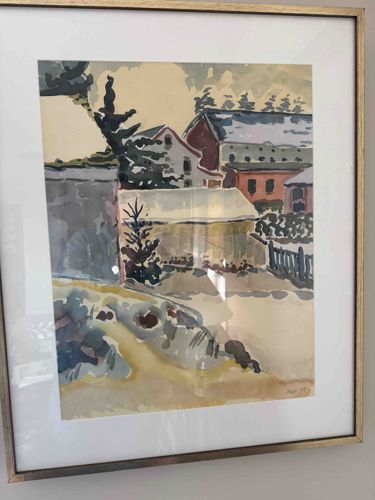
This item is a framed original watercolor painting depicting a winter village scene. The composition features several buildings, likely houses or barns, nestled amongst snow-covered landscapes and evergreen trees. The color palette primarily consists of muted tones, including shades of grey, pale yellow, brown, and red for the buildings, with dark green for the pine trees. The snow is represented by areas of white and light blue-grey washes. The style appears to be a loose, expressive watercolor technique, characterized by visible brushstrokes and areas where the pigment has bled into the paper, creating a soft, atmospheric effect. Notable features include the textured depiction of snow on rooftops and ground, and the suggestion of a fence line at the far right. A prominent dark evergreen tree dominates the left side of the composition. The visible condition suggests good preservation, though the glass covering the artwork reflects some light, obscuring minor details. There are no obvious tears, creases, or significant discoloration visible on the artwork itself. The painting is signed in the lower right corner, with the artist's name 'Nagle' and the year '1979' clearly visible. It is presented in a simple, slender gold-toned metal frame with a clean white mat, which provides a crisp border for the artwork and enhances its presentation. The overall aesthetic suggests a late 20th-century American or Canadian landscape painting, displaying competent craftsmanship in the watercolor medium. The frame appears to be in good condition, showing minimal wear.
AI Appraisal Report
Based on my visual examination of the provided image, this Winter Village Scene by Nagle, 1979, is an original watercolor painting in good condition. The signature 'Nagle' and date '1979' are clearly visible, supporting its authenticity as a work from that period. The artwork itself appears well-preserved, with no obvious tears, creases, or significant discoloration. The loose, expressive watercolor style demonstrates competent craftsmanship typical of late 20th-century landscape painting. The frame is a simple, slender gold-toned metal with a clean white mat, which complements the artwork without distracting from it, and also appears to be in good condition.
Market conditions for works by artists of this caliber, largely regional or local, tend to be steady but not highly speculative. I've considered market comparables for similar-sized, competently executed original watercolors by lesser-known artists from the same era, which generally fall within the mid to upper hundreds depending on subject appeal and provenance. While winter scenes are generally popular, the relative anonymity of the artist, 'Nagle,' means demand is primarily driven by aesthetic appeal rather than investment potential or rarity.
Factors impacting value include the good condition of both the artwork and framing, and the appealing subject matter. The primary limitation in this appraisal is the reliance on visual inspection of an image. Full authenticity verification would require in-person examination to assess the paper quality, pigment stability, and confirm the medium unequivocally. Provenance documentation, such as exhibition history or sales records from Nagle, would also significantly enhance an appraisal of authenticity and value. Without these, the appraisal remains an informed estimate based on visual cues alone.