AI estimate as of December 13, 2025 · verify with a professional before acting
AI-Generated · Verify before acting
Everything on this page is generated by AI for informational purposes only. AI can make mistakes — the AI may misidentify items or misattribute them (artist, maker, brand, designer, origin, era). This is not an official valuation and should not be used for insurance, sale, tax, estate, legal, or lending purposes — or any decision requiring a certified appraisal. It is not an authoritative claim about any person, brand, or rights holder — do not share or rely on it as a factual statement about a third party. Always consult qualified professionals before making financial decisions.
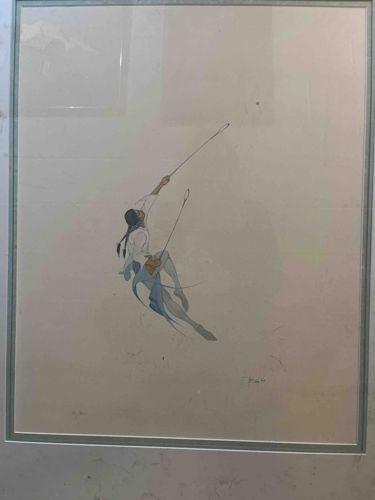
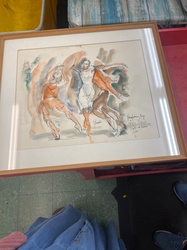
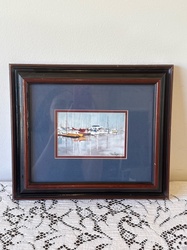
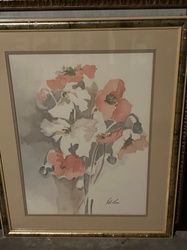
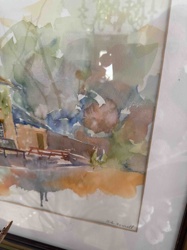
This item is a framed watercolor painting depicting a dynamic figure, likely a male, in a white garment and what appears to be a light blue or grey draping element, possibly representing movement or fabric. The figure is rendered in a minimalist style, with fluid lines and washes of color. One arm is raised high, holding a long, thin stick-like object, potentially a lasso or staff, with a loop at the end. Another similar looped object is seen trailing near the figure's lower body. The color palette is restricted to white, shades of blue and grey, and a small area of light brown or ochre on the figure's torso that suggests skin tone or an undergarment. The background is a plain, light off-white or cream color, emphasizing the central figure. The painting is housed within a silver-toned, possibly metallic, simple frame with a visible, clear glass or acrylic glazing. The matting appears to be a light-colored, possibly off-white, and is quite wide, indicating a deliberate design choice to give the artwork ample breathing room. The style suggests a modern or contemporary approach, possibly mid to late 20th century, with an emphasis on movement and essential form. There are some visible smudges or marks on the matting and glass, indicating general wear due to age and handling. A faint signature or inscription appears in the lower right corner, though it is illegible from the provided image quality. The simplicity of the composition and the expressive brushwork indicate a skilled hand, focusing on capturing the essence of action rather than intricate detail. The overall condition, besides the surface marks, seems reasonable for an item of its likely age, though closer inspection for foxing or water damage on the artwork itself would be required for a full assessment.
AI Appraisal Report
I have examined the provided image of the 'Dynamic Figure with Lasso' watercolor painting. The item presents as a framed contemporary watercolor, likely dating from the mid to late 20th century, characterized by fluid lines and a minimalist style. The limited color palette and focus on movement are indicative of a specific aesthetic choice. Condition, based on the image, appears fair for its likely age; I observe smudges on the matting and glazing, suggesting general wear rather than inherent damage to the artwork itself. However, without a physical inspection, I cannot ascertain the presence of foxing, water damage, or discoloration directly affecting the paper, which could significantly impact value. The illegible signature in the lower right corner, if authenticated, would be crucial.
Market conditions for unsigned or unidentified contemporary watercolors in this style are generally moderate. While the artwork demonstrates skill, the lack of an identifiable artist limits its premium value. Comparables for unsigned pieces of this era and quality typically range from $200-$500. Demand exists for decorative modern art, but rarity is not a significant factor without a known artist or unique historical context. The framing is appropriate but not exceptionally high-end, and the wide matting is a positive presentation factor.
Limitations in authenticity verification are significant based solely on images. A physical examination is essential to confirm the medium's authenticity, assess the true condition of the paper, and attempt to decipher the signature. Provenance documentation (e.g., bills of sale, exhibition records) would be pivotal for establishing authenticity and artist attribution, dramatically altering its value. Scientific testing for pigments or paper aging could also corroborate its age but is typically reserved for higher-value pieces.