AI estimate as of July 19, 2025 · verify with a professional before acting
AI-Generated · Verify before acting
Everything on this page is generated by AI for informational purposes only. AI can make mistakes — the AI may misidentify items or misattribute them (artist, maker, brand, designer, origin, era). This is not an official valuation and should not be used for insurance, sale, tax, estate, legal, or lending purposes — or any decision requiring a certified appraisal. It is not an authoritative claim about any person, brand, or rights holder — do not share or rely on it as a factual statement about a third party. Always consult qualified professionals before making financial decisions.
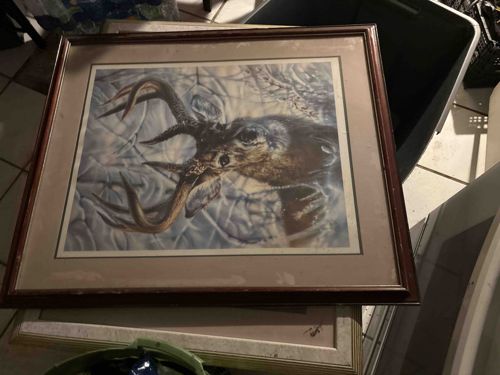
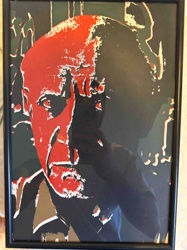
The item is a framed print depicting a deer. The print features a close-up, head-and-shoulders view of a deer with prominent antlers, suggesting it is a buck. The deer's fur appears brown, and its eyes are visible. The background is rendered in shades of blue and white, possibly indicating a snowy or wintery scene, or perhaps an abstraction of foliage in muted tones. The antlers are a focal point, displaying significant size and branching. The print is housed within a matted frame. The matboard appears to be a neutral, light brown or beige color, providing a border between the artwork and the frame. The frame itself is made of wood, exhibiting a dark reddish-brown or mahogany finish. There are visible signs of wear on the frame, including scuffs, scratches, and some lighter marks, particularly along the edges and corners, suggesting it has been handled or stored without extreme care. The glass covering the print shows some reflections, indicating it is likely standard glass rather than non-glare. The age of the piece is difficult to pinpoint precisely without maker's marks or signatures, but the style of framing and the deer motif suggest it could be from the late 20th century, possibly 1980s or 1990s. The quality of the print itself is not fully discernible, but the overall presentation is typical of mass-produced decorative wall art. No specific artist signature or edition number is visible in the provided image.
AI Appraisal Report
Upon my examination of the provided image, I assess this framed deer print. The overall condition of the piece is fair. The print itself appears to be in decent condition, though reflections on the glass limit a complete assessment of its surface. The matboard seems clean. However, the wooden frame shows clear signs of wear, including scuffs and scratches, particularly at the edges, which impacts its aesthetic appeal. Based on its visual characteristics, this item appears to be a mass-produced decorative print, likely from the late 20th century (1980s-1990s), rather than an original artwork or a limited-edition fine art print. There is no visible artist's signature, edition number, or other identifying marks that would suggest a higher artistic value or rarity.
In terms of market conditions, items like this framed deer print generally fall into the category of common decorative wall art. The demand for such items is typically low in the secondary market, outside of specific niche collectors for certain wildlife art, which this piece does not appear to represent. Comparable sales for similar mass-produced, framed wildlife prints in fair condition on platforms like eBay, Etsy, or local estate sales typically range from $15 to $40. Factors significantly impacting value include the lack of an identifiable artist, the generic nature of the print, and the wear on the frame. If the print were by a known artist, or part of a signed and numbered edition, the value would be considerably higher.
It is important to note the limitations of this appraisal due to it being based solely on images. Authenticity verification regarding the print's origin (e.g., whether it's an offset lithograph, giclee, etc.) or potential artist attribution cannot be definitively determined without a physical in-person examination. Such an examination would allow for inspection of the print's texture, paper quality, printing technique, and any hidden markings behind the mat or on the reverse of the frame. Provenance documentation would also be crucial to confirm any claims of artist or origin, and scientific testing (e.g., dating materials used) is beyond the scope of a visual appraisal but could offer further insights if needed for full authentication.