These notes were written by the person who submitted this item. Appraiser.AI has not verified them, and the AI's identification and estimate may rely on them.
AI Estimated Value
Not an official valuation
$150 - $250
AI estimate as of July 26, 2026 · verify with a professional before acting
AI-Generated · Verify before acting
Everything on this page is generated by AI for informational purposes only. AI can make mistakes — the AI may misidentify items or misattribute them (artist, maker, brand, designer, origin, era). This is not an official valuation and should not be used for insurance, sale, tax, estate, legal, or lending purposes — or any decision requiring a certified appraisal. It is not an authoritative claim about any person, brand, or rights holder — do not share or rely on it as a factual statement about a third party. Always consult qualified professionals before making financial decisions.
This analysis also relies on unverified notes provided by the user, which may be incomplete or inaccurate and could affect the result.
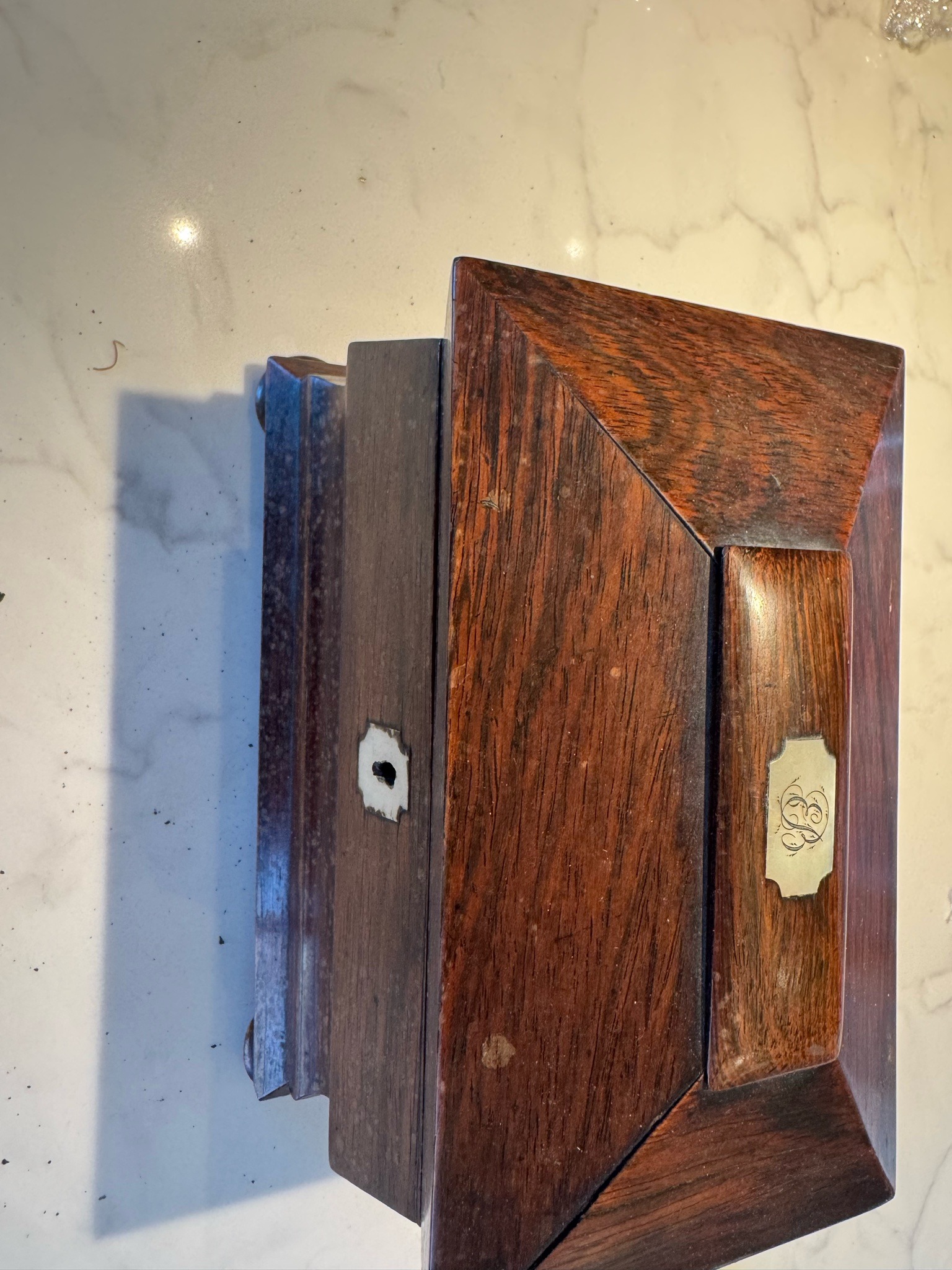
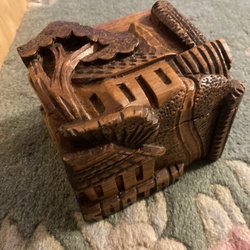
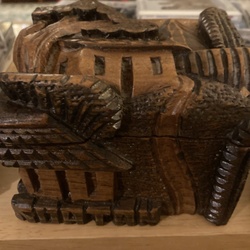
This object is a small, rectangular wooden box featuring a sarcophagus-style lid, stylistically consistent with late 18th to mid-19th century Regency or Victorian tea caddies. It is constructed from a richly grained hardwood, possibly mahogany or rosewood, displaying warm reddish-brown tones with prominent dark grain lines. The lid has a raised central rectangular panel set with a metal initial plate or cartouche, which bears an engraved monogram that appears to read 'CB' or similar script. The front panel features a keyhole with a decorative mother-of-pearl or light-colored inlay escutcheon. Small bun or bracket feet are visible along the molded base profile.
In terms of condition, the box shows noticeable signs of age and wear. The finish exhibits surface scratches, minor indentations, light discoloration, and areas of wear to the polish, particularly near the top edges and base. The metal inlay shows slight tarnishing and surface patination consistent with age. No internal construction details are visible in the provided image.
The owner provides context identifying this item as a 'Wood tea caddy.' This user-supplied attribution remains unverified, as internal compartments, foil lining, or maker's marks were not provided for in-person examination. The identification as a tea caddy is based on the characteristic sarcophagus form, keyhole feature, and period design details. Precise dating and regional origin cannot be confirmed without physical inspection.
AI Appraisal Report
Based on the provided image, I have examined this small, rectangular wooden caddy box featuring a sarcophagus-style lid, indicative of early to mid-19th-century Regency or Victorian design. Per user submission, the owner identifies this as a 'Wood tea caddy.' Based on what I can see, the piece is constructed from a richly grained hardwood, possibly mahogany or rosewood, featuring a molded base with bun feet, an engraved metal cartouche, and a light-colored inlay escutcheon around the keyhole.
I can't verify from a photo whether the internal construction, compartments, or foil lining characteristic of a functional tea caddy remain intact, as no interior images were provided. Furthermore, physical inspection would be required to examine wood joinery, hardware age, and potential hidden maker's marks. The finish shows surface scratches, minor indentations, and light wear consistent with age, which I have factored into this estimate.
Assuming this is a period-correct 19th-century wooden tea caddy in reasonable antique condition, the current secondary market value generally falls between $150 and $250. Decorative wooden boxes from this era remain popular with collectors for display, though condition and interior completeness heavily influence final pricing.
To confirm authenticity and refine this value, an in-person examination by a specialist, along with any provenance documentation or evidence of original interior fittings, would be necessary. Should physical testing or inspection reveal this piece to be a modern reproduction or a later item 'in the style of' Regency woodenware, its decorative market value would likely decrease to approximately $40 to $80.