AI estimate as of August 28, 2025 · verify with a professional before acting
AI-Generated · Verify before acting
Everything on this page is generated by AI for informational purposes only. AI can make mistakes — the AI may misidentify items or misattribute them (artist, maker, brand, designer, origin, era). This is not an official valuation and should not be used for insurance, sale, tax, estate, legal, or lending purposes — or any decision requiring a certified appraisal. It is not an authoritative claim about any person, brand, or rights holder — do not share or rely on it as a factual statement about a third party. Always consult qualified professionals before making financial decisions.
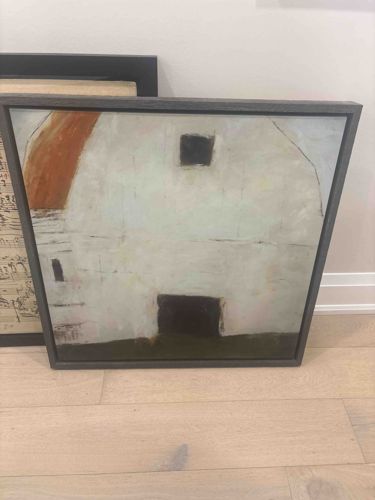
This item is an unframed work of art, likely an acrylic or oil painting on canvas or board, presented within a thin, flat-profile floating frame made of dark, possibly charcoal or espresso-colored wood. The artwork itself depicts a minimalist, abstract interpretation of a barn, dominated by a large, off-white or very light grey mass in the center, representing the main structure. A prominent curved shape in burnt orange or rust color on the left upper quadrant suggests a barn roof. There are two dark, roughly rectangular shapes: one near the top center, likely a window opening, and another larger, more irregular shape at the bottom center, indicating a barn door or entrance, both rendered in a deep brown or black. The bottom edge of the painting features a horizontal band of dark green or olive, suggesting a grassy foreground or landscape. The overall color palette is muted, with earthy tones. The brushstrokes appear visible, hinting at a textured surface, and there are subtle variations in the off-white paint, suggesting layering or washes. The visible condition appears good, with no obvious signs of damage, scratches, or significant discoloration. The frame itself shows clean lines and tight corners, indicating good craftsmanship. The modern, minimalist style of the painting suggests it is contemporary art, likely from the late 20th or early 21st century. The use of simplified forms and a subdued color scheme points to an aesthetic that aligns with modern farmhouse decor or abstract expressionism. No discernible artist's signature, marks, or manufacturing details are visible from the provided image, which would typically be located on the recto or verso of the canvas/board, or on the frame itself.
AI Appraisal Report
Upon visual examination of this abstract barn painting in a floating frame, I find its condition to be excellent. The paint surface appears stable with no visible cracks, chips, or abrasions, and the colors retain their vibrancy. The floating frame is well-constructed with tight corners, showing no signs of damage or wear. Authenticity, based solely on this image, remains limited. No artist's signature or specific markings are discernible, which would be crucial for attributing the work. Physical examination would be necessary to check the verso of the canvas/board for signatures, dates, or gallery labels. Scientific testing, such as pigment analysis, could confirm the age of the materials, but this is usually reserved for higher-value works or cases of suspected forgery.
In terms of market conditions, abstract works, particularly those with a modern farmhouse or minimalist aesthetic, are currently in high demand. The earthy tones and simplified forms appeal to a broad contemporary audience. While not unique, this painting's style is popular and marketable. Comparables would include contemporary abstract art from emerging or mid-career artists sold in online galleries or smaller art fairs, typically ranging from a few hundred to over a thousand dollars depending on size, artist reputation, and provenance. Without an identifiable artist, the value is primarily driven by its decorative appeal and condition. Rarity is low as abstract art is widely produced. Factors limiting the value here are primarily the lack of artist attribution and any verifiable provenance. Should an artist be identified, especially one with a gallery presence, the value could significantly increase.