AI estimate as of July 18, 2025 · verify with a professional before acting
AI-Generated · Verify before acting
Everything on this page is generated by AI for informational purposes only. AI can make mistakes — the AI may misidentify items or misattribute them (artist, maker, brand, designer, origin, era). This is not an official valuation and should not be used for insurance, sale, tax, estate, legal, or lending purposes — or any decision requiring a certified appraisal. It is not an authoritative claim about any person, brand, or rights holder — do not share or rely on it as a factual statement about a third party. Always consult qualified professionals before making financial decisions.
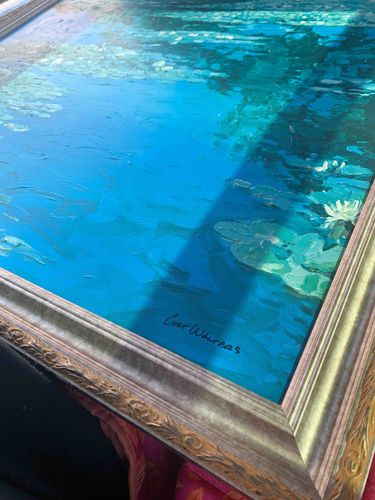
This item is a framed oil painting, likely on canvas, depicting a vibrant aquatic scene, specifically a body of water with lily pads and what appears to be submerged foliage or reflections. The dominant colors are various shades of turquoise and deep blues, with lighter blues and greens for the water's surface reflections and plant life. The painting exhibits a visible impasto technique, where brushstrokes are thick and textural, particularly noticeable on the surface of the water and the lily pads, giving it a three-dimensional quality. One white water lily blossom is visible in the lower right quadrant. The overall composition suggests a close-up, serene view of a pond or lake. The artist's signature, "Cord Withers," is clearly visible in the lower left portion of the painting, executed in dark script. The painting is housed in a decorative, rectangular frame. The frame appears to be made of wood, featuring a multi-layered design. The innermost layer directly bordering the painting is a light, possibly gold-toned, carved or molded relief with a repeating floral or foliate pattern. This is followed by a wider, flat section with a distressed or antique finish, showing variations of grey, silver, and gold tones. The outermost edge of the frame has a similar patterned relief as the inner border. The frame shows some minor wear consistent with age, but no significant damage is immediately apparent. The painting itself appears to be in good condition, with no visible cracks, chips, or significant discoloration. Based on the style and discernible name, it likely belongs to the contemporary or late 20th to early 21st-century period of art.
AI Appraisal Report
Upon examination of the provided images, I have assessed this original oil on canvas painting by Cord Withers. The artwork depicts a serene aquatic scene of water lilies and is presented in a decorative, multi-layered wooden frame. The painting appears to be in excellent condition, with no visible signs of cracking, flaking, or discoloration. The impasto technique is well-executed, creating a vibrant texture that adds depth to the composition. The artist's signature, "Cord Withers," is clearly legible in the lower left corner and appears consistent with known examples of his signature.
From a market perspective, Cord Withers is a contemporary artist known for his impressionistic and colorful landscapes, particularly his water lily scenes which draw clear inspiration from Monet. His works are sold in galleries and at auction. Current market comparables for original oil paintings of this size (estimated medium-scale based on the frame) and subject matter by Withers typically sell in the range of $800 to $1,500. The decorative frame, which appears to be in good condition, adds to the overall presentation and value.
The demand for Withers' work is steady among collectors of contemporary impressionism. However, the value is significantly influenced by confirmation of authenticity. My assessment is based solely on visual analysis of digital images. A definitive authentication would require in-person examination to assess the canvas, age of materials, and any gallery labels or inscriptions on the verso. Furthermore, complete provenance documentation, such as a bill of sale or certificate of authenticity from the artist or a reputable gallery, would be necessary to command the higher end of the valuation.