AI estimate as of September 14, 2025 · verify with a professional before acting
AI-Generated · Verify before acting
Everything on this page is generated by AI for informational purposes only. AI can make mistakes — the AI may misidentify items or misattribute them (artist, maker, brand, designer, origin, era). This is not an official valuation and should not be used for insurance, sale, tax, estate, legal, or lending purposes — or any decision requiring a certified appraisal. It is not an authoritative claim about any person, brand, or rights holder — do not share or rely on it as a factual statement about a third party. Always consult qualified professionals before making financial decisions.
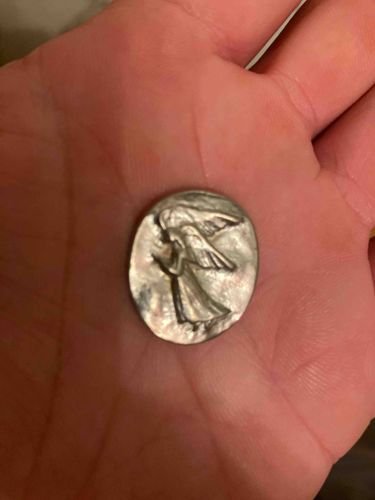
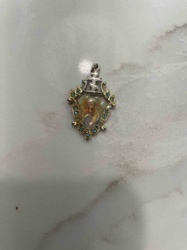
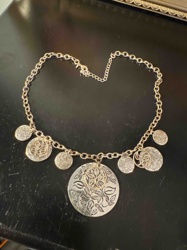
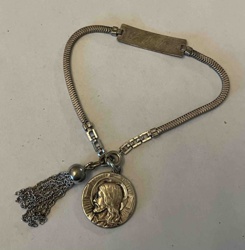
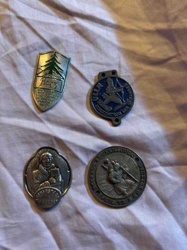
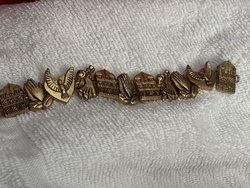
This appears to be an oval-shaped medallion or charm, crafted from a silver-toned metal, possibly pewter, sterling silver, or an alloy. The item is handheld, resting in the palm, suggesting a small size, likely less than an inch in length. The primary feature is a raised, bas-relief depiction of an angel, rendered in a simple, stylized manner. The angel figure is shown facing left, with outstretched wings, wearing a flowing gown, and seemingly in a posture of reverence or prayer. The details of the angel's face and hands are not distinctly visible, suggesting either a high degree of wear or an intentional minimalist design. The surface of the medallion exhibits a somewhat irregular, slightly mottled texture, with some areas appearing shinier than others, which could indicate polishing, natural wear, or the characteristics of the metal itself. There are no obvious maker's marks or signatures discernible from the image. The edges of the medallion appear relatively smooth, but the overall impression suggests it has been handled, possibly worn as a charm or pendant, given the slight dullness and minor surface abrasions. The style is relatively timeless, making it difficult to firmly establish an age without additional context or markings, but it could range from mid-20th century to contemporary. The craftsmanship, while not intricately detailed, conveys the angelic form effectively, characteristic of mass-produced religious or devotional items.
AI Appraisal Report
I have examined the provided image of this oval-shaped medallion/charm. Visually, it appears to be a mass-produced religious item, likely crafted from a silver-toned base metal such as pewter, a low-grade silver alloy, or pot metal. The condition suggests moderate wear consistent with a handled or worn charm; the surface exhibits minor abrasions and a somewhat dull luster, though some areas appear shinier, possibly from polishing or varied wear patterns. Authenticity as a religious charm is evident from its iconography and typical production style; however, without maker's marks or material stamps, its specific origin and metal composition cannot be definitively authenticated from imagery alone. This type of item is commonly found in religious goods stores, online marketplaces, and antique co-ops.
Market conditions for such items are generally modest. Comparables, typically mass-produced devotional charms or medallions of non-precious metals, usually retail for under $20. Demand is steady for simple religious symbols, but not high enough to drive significant value for common pieces. Rarity is very low, as these are typically mass-produced items. Factors significantly impacting value would be if it were proven to be sterling silver (which I cannot determine visually), if it bore a significant maker's mark, or if it had notable historical provenance. Without such elements, its value remains in the lower tier.
For full authentication of material, an in-person examination, including potential metal testing (e.g., specific gravity or XRF analysis), would be necessary to confirm the exact metal composition. To establish provenance or confirm a specific maker, an in-person inspection for hidden marks and comparison with known historical catalogs or expert opinions would be required.