These notes were written by the person who submitted this item. Appraiser.AI has not verified them, and the AI's identification and estimate may rely on them.
AI Estimated Value
Not an official valuation
$10-30
AI estimate as of July 19, 2025 · verify with a professional before acting
AI-Generated · Verify before acting
Everything on this page is generated by AI for informational purposes only. AI can make mistakes — the AI may misidentify items or misattribute them (artist, maker, brand, designer, origin, era). This is not an official valuation and should not be used for insurance, sale, tax, estate, legal, or lending purposes — or any decision requiring a certified appraisal. It is not an authoritative claim about any person, brand, or rights holder — do not share or rely on it as a factual statement about a third party. Always consult qualified professionals before making financial decisions.
This analysis also relies on unverified notes provided by the user, which may be incomplete or inaccurate and could affect the result.
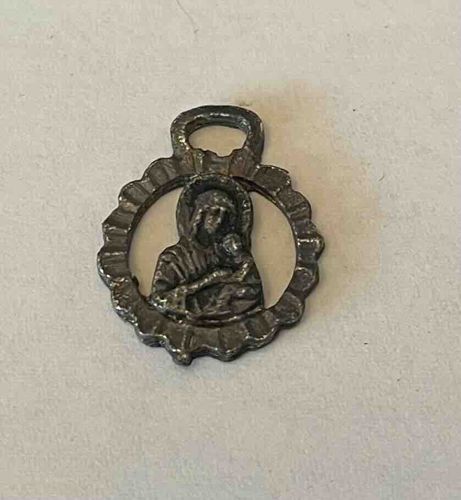
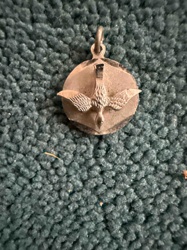
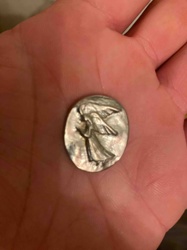
This item is a small, circular, silver-toned metal charm or pendant, approximately 1.5 cm in diameter. It features a raised, sculptural depiction of the Madonna and Child, consistent with traditional Catholic iconography. The figures of Mary and Jesus are rendered in a somewhat simple, stylized manner, with visible folds in their drapery and halos around their heads, indicating their holy status. Mary holds the infant Jesus, who is depicted cradled in her arm. The central image is set within an openwork, wavy, scalloped or fluted border, giving the charm a decorative edge resembling a flower or a sunburst. Above the main circular motif, there is an integrated, raised loop for suspension, allowing it to be worn on a chain or attached to a rosary. The metal appears to be a base metal, possibly pewter or an alloy, with a dark, oxidized patina that highlights the raised details and suggests some age. There are no discernible maker's marks or signatures visible from the provided image. The overall condition appears to be good with consistent wear indicative of its age and material, but no significant damage or repairs are apparent. The craftsmanship, while not exquisitely fine, is well-executed for its size and material, showing a clear, recognizable religious scene. It likely dates from the mid-to-late 20th century given its appearance and commonality.
AI Appraisal Report
I have examined the provided images and description of this Madonna and Child scalloped charm. Based on its appearance, specifically the probable base metal composition (likely pewter or an alloy) with an oxidized patina, and the somewhat stylized, yet clear, depiction, I assess its condition as good, consistent with age and material wear. The scalloped border is intact, and the suspension loop appears sturdy.
From the visual evidence, it presents as an authentic religious charm from the mid-to-late 20th century. However, without direct physical examination, I cannot definitively confirm the metal composition, nor rule out mass-produced replicas that might exist for such common religious iconography. Factors significantly impacting value for such pieces include material, age, provenance, and maker's marks, of which only material and approximate age can be speculated from the image.
The market for common religious charms of this type and material is generally modest. Comparables often include similar pewter or base metal devotional items found at antique markets, religious goods stores, or online platforms. These items are not rare; mass production makes them widely available. Demand is primarily from collectors of religious memorabilia or individuals seeking a personal devotional item, rather than for intrinsic material or artistic value. The lack of precious metals, significant age, or identifiable artistic merit limits its high-end market appeal.
For full authentication, a physical examination would be crucial to test metal composition, inspect for hidden maker's marks, and verify manufacturing techniques. Provenance documentation, charting its ownership history, would significantly enhance authenticity and value, but is unlikely for an item of this nature. Definitive dating without provenance would require stylistic analysis or, less practically, scientific material testing.