These notes were written by the person who submitted this item. Appraiser.AI has not verified them, and the AI's identification and estimate may rely on them.
AI Estimated Value
Not an official valuation
$250-400
AI estimate as of December 7, 2025 · verify with a professional before acting
AI-Generated · Verify before acting
Everything on this page is generated by AI for informational purposes only. AI can make mistakes — the AI may misidentify items or misattribute them (artist, maker, brand, designer, origin, era). This is not an official valuation and should not be used for insurance, sale, tax, estate, legal, or lending purposes — or any decision requiring a certified appraisal. It is not an authoritative claim about any person, brand, or rights holder — do not share or rely on it as a factual statement about a third party. Always consult qualified professionals before making financial decisions.
This analysis also relies on unverified notes provided by the user, which may be incomplete or inaccurate and could affect the result.
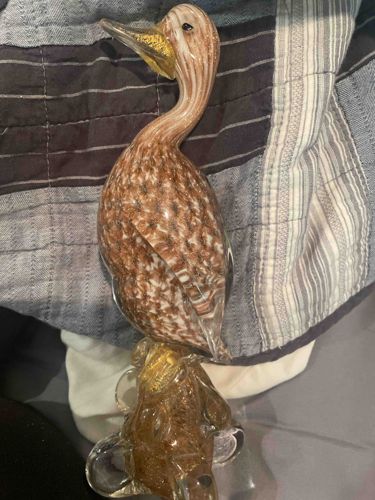
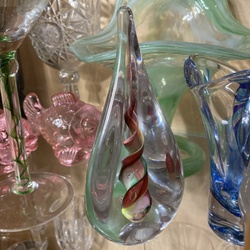
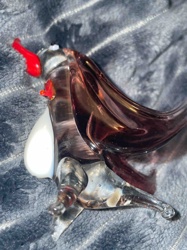
This exquisite item is a blown glass figure depicting a stylized duck. The primary material is glass, meticulously crafted to mimic the appearance of a waterfowl. The body of the duck, including its head, elongated neck, and main body, is composed of clear glass infused with a rich brown and white speckled or striped pattern. This patterning is achieved through the use of aventurine (copper or gold flecks, as indicated by context), which provides a shimmering quality and depth to the coloration, particularly noticeable in the brown areas. The glass incorporates clear sections, especially at the tips of what appear to be wings or tail feathers, and the base. The duck's beak is distinctively yellow, heavily impregnated with golden aventurine, giving it a sparkling, golden-yellow appearance. Small, opaque black glass dots form the eyes, adding a touch of realism to the otherwise artistic representation. The figure stands on a separate, clear glass base, which is also infused with brown or golden aventurine, particularly in the central support column. The base itself appears somewhat irregularly shaped, possibly suggesting a free-form or organic design, with clear glass elements extending outwards, perhaps forming feet or a decorative stand. There are no readily visible cracks, chips, or significant damage, suggesting good overall preservation. The craftsmanship indicates a hand-blown technique, characteristic of Murano glasswork, where artisans manipulate molten glass to create intricate forms and internal patterns. The style suggests a mid-20th century to contemporary decorative art piece, leaning towards a more naturalistic yet abstract avian form. The infusion of aventurine is a key quality indicator, highlighting sophisticated glassmaking techniques.
AI Appraisal Report
Based on my visual examination of the Murano Blown Glass Duck Figure with Aventurine, the item appears to be in excellent condition, with no visible cracks, chips, or significant damage. The craftsmanship, particularly the hand-blown technique and sophisticated use of aventurine, is consistent with Murano glasswork. The clear glass infused with brown and white speckled patterns, coupled with the shimmering gold aventurine in the beak and base, points to a decorative art piece from the mid-20th century to contemporary period. Market conditions for decorative Italian art glass, especially pieces with aventurine, remain steady among collectors. Comparable sales for well-preserved Murano animal figures of this size and complexity, especially those featuring aventurine, fall within this range. The demand for authentic Murano pieces is consistent, though rarity depends on the specific artisan or studio, which is not identifiable from images alone. A key factor impacting value positively is the excellent condition and the attractive use of aventurine in multiple parts of the sculpture. Without physical inspection, I cannot definitively authenticate the piece as originating from a specific Murano studio or artisan. Full authentication would require an in-person examination to search for pontil marks, signatures, or acid stamps, along with provenance documentation suchor scientific analysis of the glass composition.