AI estimate as of October 22, 2025 · verify with a professional before acting
AI-Generated · Verify before acting
Everything on this page is generated by AI for informational purposes only. AI can make mistakes — the AI may misidentify items or misattribute them (artist, maker, brand, designer, origin, era). This is not an official valuation and should not be used for insurance, sale, tax, estate, legal, or lending purposes — or any decision requiring a certified appraisal. It is not an authoritative claim about any person, brand, or rights holder — do not share or rely on it as a factual statement about a third party. Always consult qualified professionals before making financial decisions.
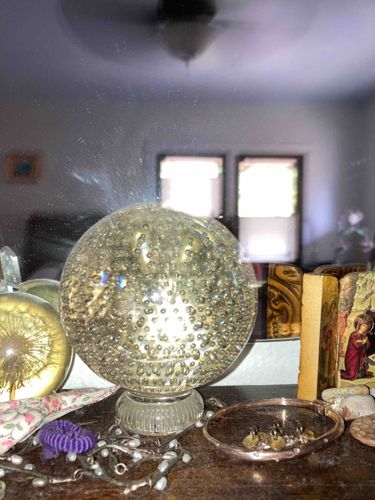
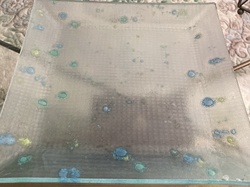
This item is a decorative clear glass sphere, approximately medium to large in size, supported by a distinct clear glass pedestal base. The spherical body is entirely filled with a multitude of small, irregularly sized air bubbles, giving it a effervescent or 'controlled-bubble' appearance sometimes referred to as 'controlled bubble' or 'bullseye' glass technique. These bubbles are distributed throughout the interior of the sphere, creating a visually dynamic effect that can refract and reflect light. The glass itself appears to be clear, possibly with a very slight yellowish or amber tint, which could be an inherent quality of the glass composition or a perception due to ambient lighting. The surface of the sphere reflects its surroundings, including what appears to be a ceiling fan and windows, indicating its polished and smooth exterior. The base is also made of clear glass, featuring a ribbed or fluted design around its circumference, providing stability and a classical aesthetic. No visible manufacturing marks, signatures, or stamps are discernible from the provided image. The overall condition appears to be good with a clean, polished surface, though minor dust specks are visible on parts of the wider reflective surface behind it, likely on a mirror or glass enclosure. There are no immediately obvious chips, cracks, or repairs. This type of decorative glass artwork typically became popular in the mid-20th century, particularly from the 1950s onwards, and continues to be produced today, suggesting a possible vintage to modern age. Its craftsmanship, characterized by the controlled bubble technique, indicates intentional design and production, likely for ornamental purposes in home decor.
AI Appraisal Report
Upon visual examination of the provided image, I find this clear glass sphere with internal bubbles on a pedestal base to be in good overall condition. The glass surfaces appear clean and polished, with no immediately visible chips, cracks, or repairs. The controlled bubble technique is consistently applied throughout the sphere, creating an attractive visual effect. The clear glass pedestal base, with its ribbed design, provides stable support and a classical touch. The slight yellowish or amber tint observed could be inherent to the glass composition or merely a reflection of ambient light.
This type of decorative art, commonly referred to as 'controlled bubble' or 'bullseye' glass, gained popularity from the mid-20th century onwards. While charming, these pieces are relatively common in the general decorative arts market. Factors influencing value include the reputation of the maker, the complexity and artistry of the bubble patterns, and overall size. Without any discernible maker's marks or signatures, its value is benchmarked against similar unsigned decorative glass items.
Market conditions for such pieces are generally stable, with moderate demand from collectors of vintage and decorative glass. However, they are not highly rare. Value is primarily driven by aesthetic appeal and condition. In-person examination would be required to verify the absence of any subtle flaws, determine the exact composition of the glass, and search for any faint manufacturer's marks that might not be visible in the image. Provenance documentation could also significantly impact value by linking it to a known glassworks or designer. Without such information, its authenticity as a specific designer piece versus a mass-produced decorative item cannot be definitively ascertained from images alone.