AI Appraisal Estimate

AI-generated estimates · not official valuations

From the user

What was submitted

Photo and notes provided by the user — not generated by AI

Submitted item photo
Submitted photo · June 28, 2026

User's notes

No additional notes provided.

AI analysis below

AI appraisal

AI analysis & estimate

AI-Generated · Verify before acting

Everything below is generated by AI for informational purposes only. AI can make mistakes — the AI may misidentify items or misattribute them (artist, maker, brand, designer, origin, era). This is not an official valuation and should not be used for insurance, sale, tax, estate, legal, or lending purposes — or any decision requiring a certified appraisal. It is not an authoritative claim about any person, brand, or rights holder — do not share or rely on it as a factual statement about a third party. Always consult qualified professionals before making financial decisions.

Read the full disclaimer

AI Identification

·Not independently authenticated·Verify before acting

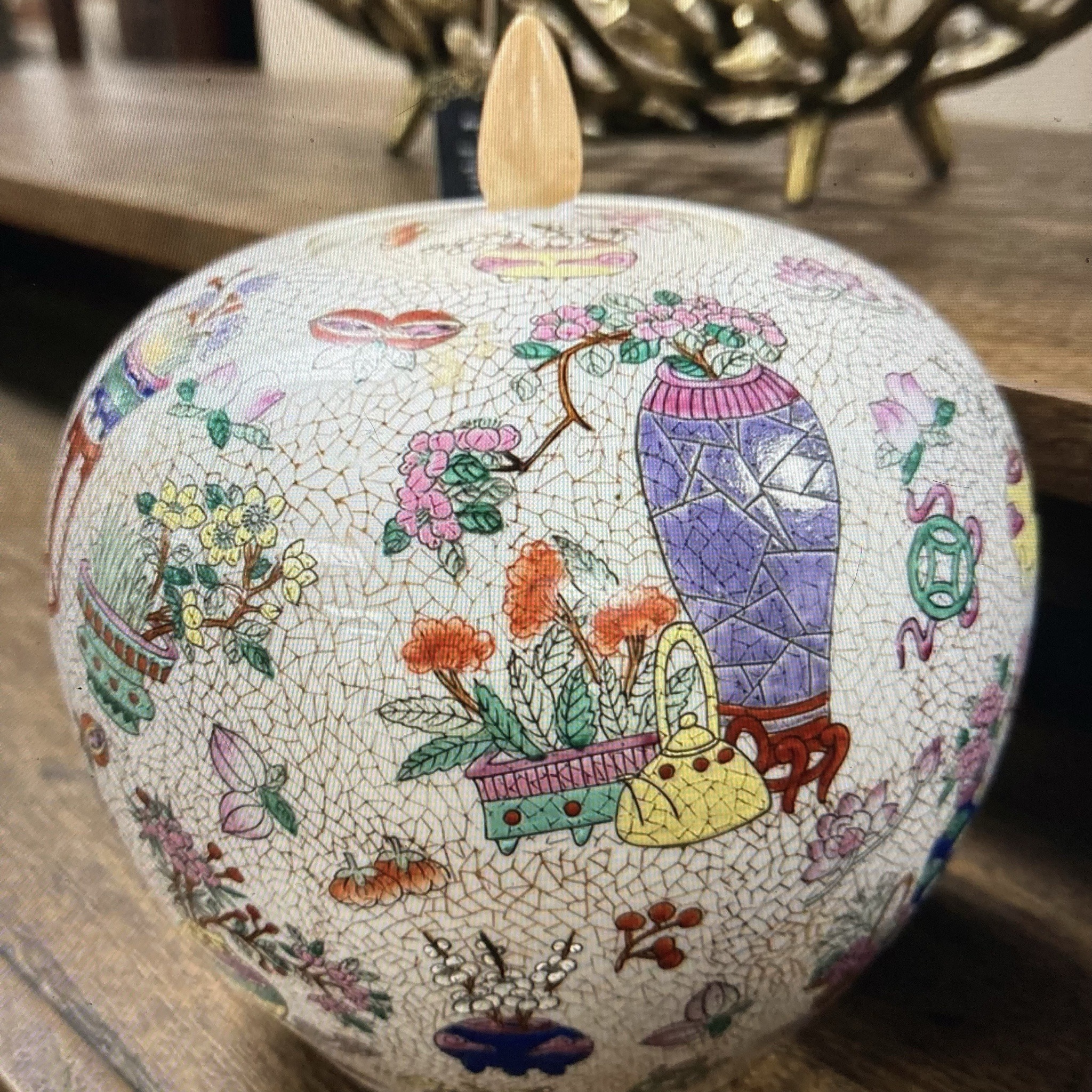
Ginger jar with crackle-glaze and polychrome floral motifs

Ceramics and Porcelain

AI Estimated Value

·Not an official valuation·Verify before acting

$400 - $800

As of June 28, 2026

AI Item Analysis

·AI can make mistakes·Verify before acting
This item appears to be a ceramic ginger jar or covered vessel featuring a distinctive crackle-glaze finish (ge-type style) over an off-white or cream-colored ground. The globular body is decorated with various polychrome enamel motifs consistent with Chinese 'Hundred Antiques' or 'Precious Objects' iconography. These decorations include a large purple crackle-patterned vase holding pink flowers, a yellow tea pot, potted blossoms, butterflies, and various auspicious symbols. The color palette is dominated by pinks, greens, purples, and oranges. The lid is capped with a pale, tear-shaped finial. The overall aesthetic is stylistically consistent with late 19th-century or 20th-century decorative ceramics, possibly in the Famille Rose palette style. No maker's marks or signatures are visible in the provided image; therefore, the attribution remains hypothetical and the age is unverified without physical inspection. The crackle effect appears uniform throughout the surface, which could be an intentional decorative choice. Condition-wise, the visible surface shows no overt chips or cracks beyond the intentional crazing, though some surface dust is present. All identifications of material and age are based on visual indicators and would require expert in-person verification to determine if the piece is a period work or a later decorative reproduction.
AI Appraisal Report

·AI can make mistakes·Verify before acting
I have examined the digital image of the ceramic ginger jar. Based on what I can see, the item displays characteristics consistent with Late Qing Dynasty or Early Republic period 'Hundred Antiques' decorative ware. The polychrome enamels and intentional crackle-glaze suggest a 19th or 20th-century production. However, I cannot verify the specific age or material composition from a photo alone; a physical inspection is required to determine if the piece is a period work or a later 20th-century decorative reproduction. The value range of $400 - $800 is based on the hypothesis that the piece is a late 19th-century or early 20th-century Chinese export vessel in good condition. Market demand for Chinese polychrome ceramics remains steady, particularly for vessels with auspicious 'Precious Objects' iconography. However, this estimate depends entirely on the piece being an antique of that period. If physical examination or scientific testing were to identify this as a modern 'in the style of' reproduction from the mid-to-late 20th century, the market value would likely decrease to the $50 - $150 range. To confirm a more accurate valuation, I would need to perform an in-person inspection to look for signs of wear consistent with age, examine the foot rim for clay body characteristics, and search for any marks that may be hidden under the base. Authentication would require evaluating the depth of the crackle-glaze and the quality of the enamel application. Until such a physical assessment is conducted by a specialist, this estimate remains a working hypothesis based on visual indicators only. The presence of surface dust suggests the item has been in a domestic environment, but the lack of visible damage in the photo supports a mid-range estimate for this type of decorative art.

Get your items appraised

Instant estimates of your treasures with AI-powered appraisals

Browse More Appraisals