AI Appraisal Estimate

AI-generated estimates · not official valuations

From the user

What was submitted

Photo and notes provided by the user — not generated by AI

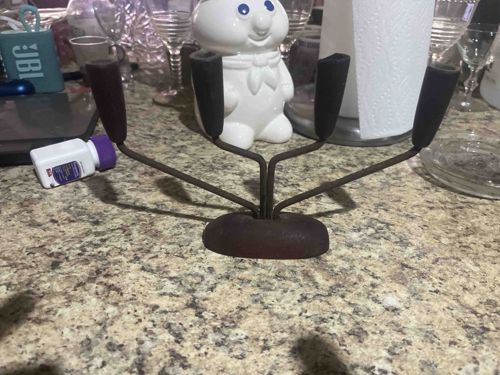
Submitted item photo
Submitted photo · June 26, 2026

User's notes

No additional notes provided.

AI analysis below

AI appraisal

AI analysis & estimate

AI-Generated · Verify before acting

Everything below is generated by AI for informational purposes only. AI can make mistakes — the AI may misidentify items or misattribute them (artist, maker, brand, designer, origin, era). This is not an official valuation and should not be used for insurance, sale, tax, estate, legal, or lending purposes — or any decision requiring a certified appraisal. It is not an authoritative claim about any person, brand, or rights holder — do not share or rely on it as a factual statement about a third party. Always consult qualified professionals before making financial decisions.

Read the full disclaimer

AI Identification

·Not independently authenticated·Verify before acting

Mid-Century Modern Four-Arm Wrought Iron Candelabra

Antique and Vintage Home Decor / Lighting

AI Estimated Value

·Not an official valuation·Verify before acting

$125 - $225

As of June 26, 2026

AI Item Analysis

·AI can make mistakes·Verify before acting
This item is a four-arm tabletop candelabra, characteristic of the Mid-Century Modern style popular during the 1950s and 1960s. It is constructed from dark, likely wrought iron or cast iron with a matte black or dark brown finish. The piece features a central, heavy oval-shaped base from which four slender, curved metal arms extend outward in a symmetrical, fan-like arrangement. Each arm terminates in a cylindrical, tulip-style candle cup designed to hold standard taper candles. The craftsmanship suggests a minimalist aesthetic, often associated with Scandinavian or American modernist metalwork of the mid-20th century. Regarding its condition, the piece shows significant signs of age and environmental exposure. There is visible surface oxidation, rust, and pitting, particularly on the base and along the thin supporting arms. The original finish appears to be thinning or worn away in several areas, revealing a reddish-brown iron patina beneath. Despite the surface wear, the structural integrity seems intact without obvious bends or breaks in the metal. No maker's marks or signatures are immediately visible in the provided image, but the silhouette is highly indicative of period pieces produced by manufacturers such as Dansk or similar studio artists during the modernist era. The quality reflects a utilitarian yet artistic approach to home decor from that period.

AI Appraisal Report

·AI can make mistakes·Verify before acting
Based on my visual examination of the four-arm wrought iron candelabra, I have evaluated it as a genuine piece of Mid-Century Modern metalwork, likely dating from the 1950s or 1960s. The silhouette, characterized by its oval base and symmetrical tulip cups, strongly reflects the 'Scandi-Modern' influence popular in both European and American studio pottery and metalware of that era. While unsigned, the design language is consistent with the minimalist output of manufacturers like Dansk or the aesthetic of designers like Quistgaard. The structural integrity remains sound, although the condition is 'fair' due to extensive surface oxidation and pitting. This 'as-found' patina can be desirable for some collectors, but the lack of a original finish or a prestigious maker’s mark limits its ceiling in the high-end market. Current market conditions for MCM metal accents remain stable; however, buyers currently favor pieces by known designers (e.g., Jens Quistgaard for Dansk or Arthur Umanoff) which can fetch $300-$600. Without a mark, this piece is valued as an attractive 'at-large' period accessory. It is important to note that this appraisal is based solely on digital images. A physical inspection is required to confirm the metal's composition and to search for faint stamped signatures under the oxidation that I could not detect here. Full authentication would require provenance documentation or a match in a period manufacturer catalog. Furthermore, scientific testing (XRF) would be the only way to definitively confirm the iron's impurities to match specific regional foundries if no mark is found.

Get your items appraised

Instant estimates of your treasures with AI-powered appraisals

Browse More Appraisals