These notes were written by the person who submitted this item. Appraiser.AI has not verified them, and the AI's identification and estimate may rely on them.
AI Estimated Value
Not an official valuation
$40-$70
AI estimate as of November 12, 2025 · verify with a professional before acting
AI-Generated · Verify before acting
Everything on this page is generated by AI for informational purposes only. AI can make mistakes — the AI may misidentify items or misattribute them (artist, maker, brand, designer, origin, era). This is not an official valuation and should not be used for insurance, sale, tax, estate, legal, or lending purposes — or any decision requiring a certified appraisal. It is not an authoritative claim about any person, brand, or rights holder — do not share or rely on it as a factual statement about a third party. Always consult qualified professionals before making financial decisions.
This analysis also relies on unverified notes provided by the user, which may be incomplete or inaccurate and could affect the result.
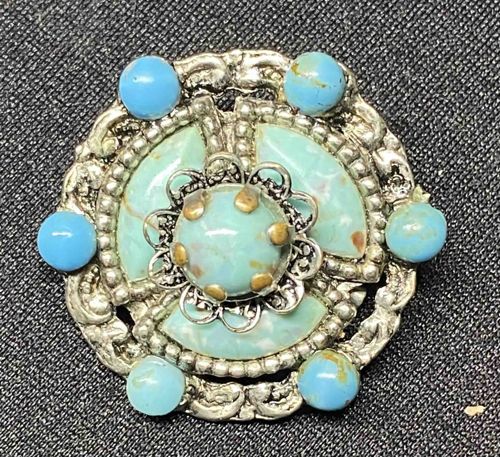
This is a vintage brooch featuring a striking combination of turquoise-colored stones and silver-tone metalwork. The brooch has a circular, almost floral or star-like shape, with an approximate diameter of 1.5 to 2 inches. The base metal appears to be a silver-tone alloy, possibly pewter or a plated metal, exhibiting an antiqued or oxidized finish to highlight the embossed and filigree details. The overall design suggests a bohemian, Southwestern, or possibly even a Victorian revival aesthetic, popular in the mid-20th century.
The central element is a large, domed, round turquoise-colored cabochon stone, likely a polymer or treated, reconstituted stone given the uniform color and internal matrix patterns. This central stone is surrounded by a silver-tone filigree setting resembling petals or scrollwork, further accented by small, round, raised gold-tone dots or beads that contrast with the silver. Surrounding this central motif are three larger, irregularly shaped, flat turquoise-colored stones, often referred to as 'cabochons' or 'tiles,' which form a triangular or fan-like arrangement, separated by sections of the textured silver-tone base. These three stones also exhibit a mottled turquoise color with hints of brown or reddish matrix, suggesting natural turquoise or a good imitation.
Around the outer perimeter of the brooch are six smaller, spherical, sky-blue stones, which appear to be either polished beads or cabochons, attached to the silver-tone frame. The silver-tone frame itself is highly decorative, featuring a beaded edge and ornate, scrolling patterns with a slightly raised, embossed texture. The 'vintage' context suggests an age ranging from the 1950s to the 1980s. The condition appears to be good for its age, with visible patina on the metalwork and minor wear appropriate for a used vintage item. No specific maker's marks or signatures are visible in the provided image, which is common for many costume jewelry pieces of this era. The craftsmanship, while not fine jewelry grade, is consistent with quality vintage costume jewelry, showing intricate detailing.
AI Appraisal Report
After a thorough visual examination of the provided image of the Vintage Turquoise and Silver-Tone Brooch, I assess its overall condition as good for its age, exhibiting typical wear and patina consistent with a used vintage item. The artistry of the metalwork, with its intricate filigree and beaded edge, points to a mid-20th century costume jewelry piece (likely 1950s-1980s). The absence of visible maker's marks is common for such items.
The turquoise-colored stones appear to be a mix of natural-looking reconstituted or treated material and possibly polymer, especially the uniform central cabochon. While attractive, these are not high-grade natural turquoise. The silver-tone metal is likely an alloy or plated base metal, given the period and style. This is considered costume jewelry, not fine jewelry.
In terms of market conditions, vintage costume jewelry featuring turquoise-colored stones and a Southwestern or Bohemian aesthetic has a consistent, moderate demand. The piece’s intricate detailing and good condition for its age are positive factors. However, the use of non-precious metals and imitation or reconstituted stones limits its intrinsic value. Rarity is not a significant factor here; similar pieces were produced in volume during its era.
To fully verify authenticity and precise materials, an in-person examination would be crucial. This would allow for an accurate assessment of the stones' composition (e.g., specific gravity or spectroscopic analysis for turquoise identification), precise metal testing, and a detailed search for faint hallmarks. Provenance documentation, if available, would also add to its historical value. Based on the visual evidence alone, without such in-depth verification, the valuation reflects its standing as a well-preserved vintage costume jewelry item.