AI Appraisal Estimate

AI-generated estimates · not official valuations

From the user

What was submitted

Photo and notes provided by the user — not generated by AI

Submitted item photo
Submitted photo · May 25, 2026

User's notes

No additional notes provided.

AI analysis below

AI appraisal

AI analysis & estimate

AI-Generated · Verify before acting

Everything below is generated by AI for informational purposes only. AI can make mistakes — the AI may misidentify items or misattribute them (artist, maker, brand, designer, origin, era). This is not an official valuation and should not be used for insurance, sale, tax, estate, legal, or lending purposes — or any decision requiring a certified appraisal. It is not an authoritative claim about any person, brand, or rights holder — do not share or rely on it as a factual statement about a third party. Always consult qualified professionals before making financial decisions.

Read the full disclaimer

AI Identification

·Not independently authenticated·Verify before acting

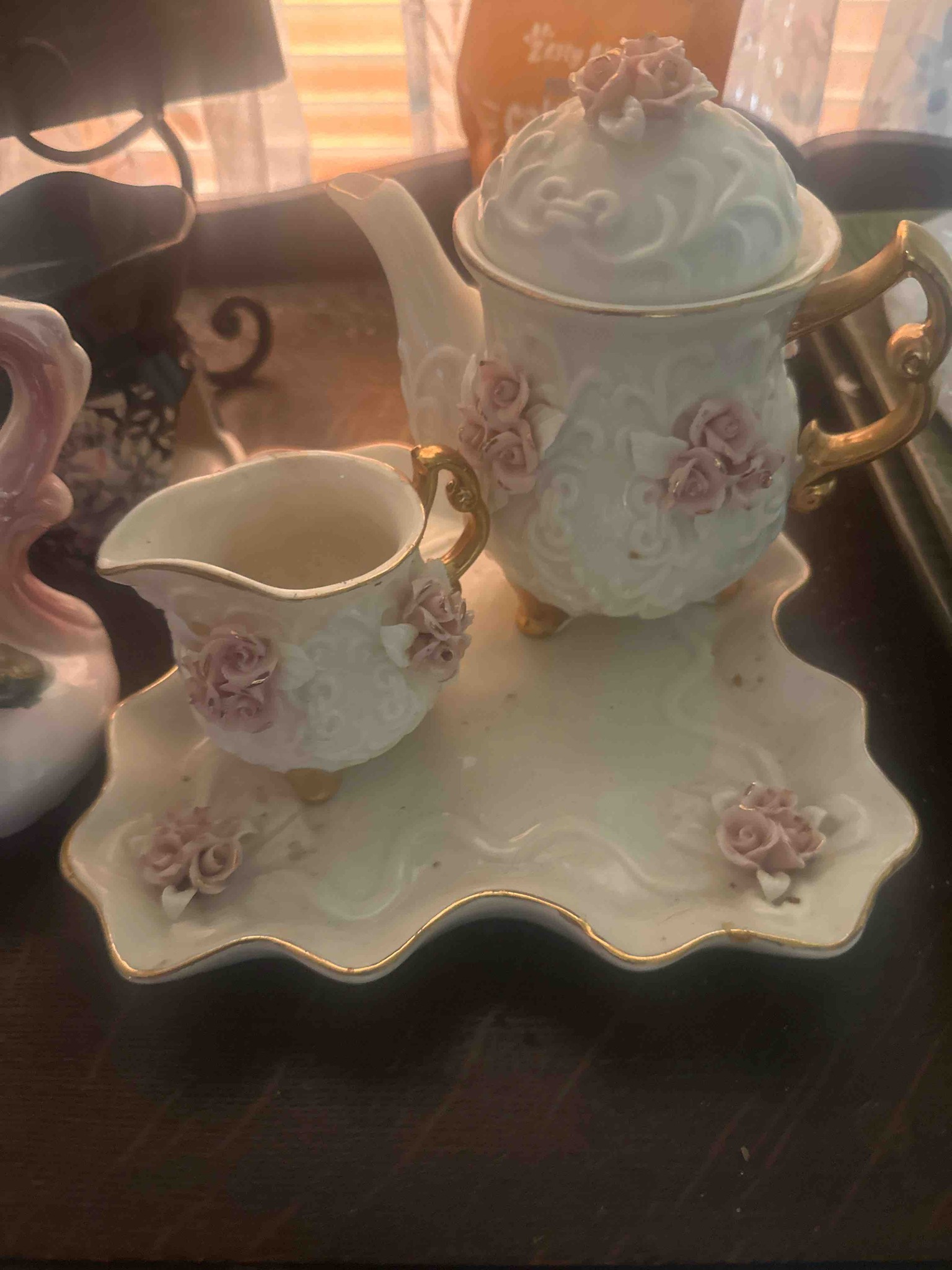
Vintage Capodimonte-Style Porcelain Miniature Tea Set with Tray

Decorative Arts / Collectible Ceramics

AI Estimated Value

·Not an official valuation·Verify before acting

$45.00 - $75.00

As of May 25, 2026

AI Item Analysis

·AI can make mistakes·Verify before acting
This is a highly decorative three-piece miniature porcelain set, likely of mid-20th-century vintage, consisting of a lidded teapot, a small creamer/pitcher, and a matching scalloped display tray. The set is crafted from white ceramic or porcelain and characterized by 'Capodimonte-style' applied three-dimensional floral work. Each piece features delicate hand-formed dusty pink rose blossoms with small green-tipped leaves. The primary body of the vessels is adorned with raised slip-trailed scrollwork (baroque or rococo revival styling) that creates a textural, embossed effect. Gilt (gold-tone) accents are heavily applied to the decorative handles, the finial, the scroll-style feet of the vessels, and along the undulating, scalloped rim of the tray. The teapot features a ornate gold handle and a pointed lid topped with a rose finial. Regarding condition, the set shows visible signs of age and handled use, including dust accumulation in crevices, slight tarnishing or wear to the gold plating on the handles and feet, and minor surface staining on the tray. The applied roses appear mostly intact, though these delicate structures are prone to micro-chipping on petal edges. The craftsmanship indicates a mass-market decorative item designed to emulate high-end European porcelain, likely originating from Japan or Italy during the 1950s-1970s.
AI Appraisal Report

·AI can make mistakes·Verify before acting
Based on my visual examination of this miniature porcelain tea set, I have categorized it as a mid-20th-century decorative accessory in the 'Capodimonte style.' While the set features the characteristic applied floral work and baroque scrollwork associated with Italian tradition, the execution suggests a mass-market reproduction, likely originating from Italy or Japan between 1955 and 1975. The glaze and gilding techniques are typical of 'giftware' exports rather than the high-fired fine porcelain produced by the Ginori factory or historic Royal Factory at Naples. The condition shows signs of age-related wear, specifically 'kiln dust' and minor tarnishing on the gilt handles and feet. The applied roses—though seemingly intact—show the characteristic fragility of this style. In the current secondary market, demand for mid-century kitsch and miniature ceramics remains stable but modest. Comparables for unsigned Capodimonte-style miniatures typically sell in the $30 to $80 range at estate auctions. The presence of the matching scalloped tray significantly helps maintain the higher end of that value range, as complete sets are rarer than individual vessels. Limitations: This appraisal is based strictly on photographic evidence. Without a physical inspection, I cannot verify the presence of an underglaze 'N' with crown mark, which would indicate a specific Italian origin. An in-person examination is required to check for micro-chips on the petals and to confirm if the gilding is 22k gold leaf or a metallic luster paint. High-resolution photos of the underside are necessary to determine if the clay body is true hard-paste porcelain or a more porous earthenware/majolica.

Get your items appraised

Instant estimates of your treasures with AI-powered appraisals

Browse More Appraisals