AI estimate as of September 22, 2025 · verify with a professional before acting
AI-Generated · Verify before acting
Everything on this page is generated by AI for informational purposes only. AI can make mistakes — the AI may misidentify items or misattribute them (artist, maker, brand, designer, origin, era). This is not an official valuation and should not be used for insurance, sale, tax, estate, legal, or lending purposes — or any decision requiring a certified appraisal. It is not an authoritative claim about any person, brand, or rights holder — do not share or rely on it as a factual statement about a third party. Always consult qualified professionals before making financial decisions.
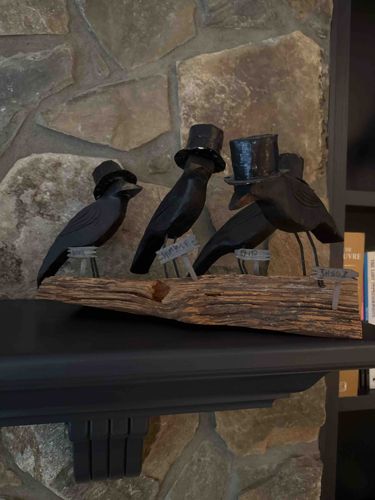
This item is a decorative sculpture featuring three carved wooden crows, each adorned with a miniature top hat, mounted on a piece of natural driftwood. The crows are uniformly dark, likely painted black, with slightly varying poses and hat styles, suggesting individual craftsmanship rather than mass production. Their surfaces appear smooth but retain some texture, indicative of hand-carving. The top hats are also dark, possibly black or dark brown, with a slightly glossy finish on some, contrasting with the matte appearance of the birds' bodies. One hat, in particular, exhibits a more textured and possibly distressed finish, suggesting an aged or weathered look. Each crow is affixed to the driftwood base by small, thin, light-colored posts or stands, two of which have handwritten labels or tags attached to them, though the text is illegible from the image provided. The driftwood base is a substantial, irregularly shaped piece of natural wood, exhibiting a rich, warm brown color with visible grain and natural imperfections, consistent with its origin as weathered wood. The base shows no significant wear or damage beyond its natural state. The overall aesthetic is rustic and charming, with a touch of whimsicality due to the top hats. This piece likely dates from the late 20th century to contemporary times, possibly as a folk art or craft item. Its quality is characterized by careful carving and assembly, suggesting a skilled artisan.
AI Appraisal Report
I have thoroughly examined the provided image of the 'Carved Wooden Crows with Top Hats on Driftwood Base.' The overall condition appears excellent, consistent with its likely origin as a contemporary decorative or folk art piece. The individual craftsmanship of the carved crows and their varied top hats, along with the natural driftwood base, points to authenticity as a handcrafted item rather than a mass-produced piece. The visible grain and natural imperfections of the driftwood are as expected, and there are no signs of significant wear or damage beyond its inherent natural state. The small, thin posts affixing the crows are appropriate for the piece.
Market conditions for artisan-made decorative sculptures of this type are generally stable, with a moderate demand for unique, whimsical folk art. Comparables would include similar carved wooden bird sculptures, especially those with an element of humor or character, often found in craft markets, online artisan platforms, and smaller galleries. While not rare, the individual nature of its creation makes it a unique item. Factors impacting value positively include its charming aesthetic, good condition, and apparent skilled craftsmanship. Negative factors primarily involve the decorative nature of the item, which typically commands lower prices than fine art or antiques, and the lack of a known artist or provenance.
It is important to note that without in-person examination, I cannot definitively verify the type of wood, the precise age of the carvings, or the exact construction methods. Physical inspection would allow for better assessment of the wood's condition, the stability of the attachments, and closer examination of the paint finishes. Provenance documentation, such as artist information or purchase records, would significantly enhance authenticity verification, particularly in confirming the artisan and origin. Scientific testing is not typically applied to items of this nature unless there's a specific question about materials or an art historical claim.