AI Appraisal Estimate

AI-generated estimates · not official valuations

From the user

What was submitted

Photo and notes provided by the user — not generated by AI

Submitted item photo
Submitted photo · June 27, 2026

User's notes

No additional notes provided.

AI analysis below

AI appraisal

AI analysis & estimate

AI-Generated · Verify before acting

Everything below is generated by AI for informational purposes only. AI can make mistakes — the AI may misidentify items or misattribute them (artist, maker, brand, designer, origin, era). This is not an official valuation and should not be used for insurance, sale, tax, estate, legal, or lending purposes — or any decision requiring a certified appraisal. It is not an authoritative claim about any person, brand, or rights holder — do not share or rely on it as a factual statement about a third party. Always consult qualified professionals before making financial decisions.

Read the full disclaimer

AI Identification

·Not independently authenticated·Verify before acting

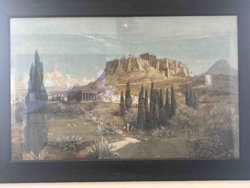
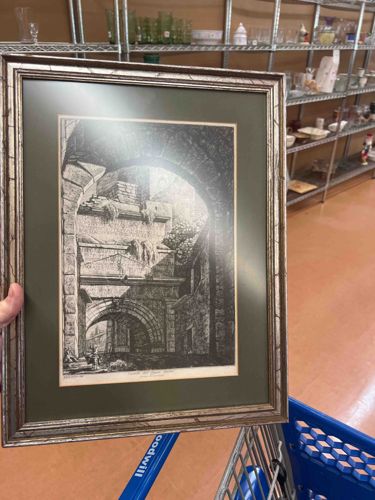
Framed Etching Repro of 'Veduta del Piano Inferiore'

Wall Art / Prints

AI Estimated Value

·Not an official valuation·Verify before acting

$150 - $250

As of June 27, 2026

AI Item Analysis

·AI can make mistakes·Verify before acting
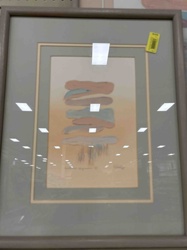
This item is a framed monochrome print, likely an etching or a high-quality lithographic reproduction, depicting a classical architectural scene in the 'Capriccio' or 'Veduta' style, notably similar to the works of Giovanni Battista Piranesi. The artwork portrays a series of monumental stone arches and vaulted ceilings with overgrown vegetation, utilizing dramatic chiaroscuro to emphasize depth and ruin. The print is set within a sage green or olive-toned mat board that provides a deep border. It is housed in a decorative silver-toned frame featuring a distinctive 'cracked' or distressed faux-finish texture with tiered molding. Below the image, handwritten or printed script is visible, identifying the piece as 'Veduta del Piano Inferiore' (View of the Lower Level). The physical condition appears fair to good; while the glass and art seem intake, the frame exhibits significant intentional distressing that may mask minor scuffs or surface wear. There are no obvious signs of water damage or foxing on the paper from this perspective. The style suggests a late 20th-century decorative framing of a much older 18th-century design. The craftsmanship is typical of commercial gallery or high-end retail framing, designed to evoke a vintage, European aesthetic.
AI Appraisal Report

·AI can make mistakes·Verify before acting
Upon visual examination of this framed reproduction of 'Veduta del Piano Inferiore,' I have identified the work as a decorative 20th-century print modeled after the 18th-century etchings of Italian master Giovanni Battista Piranesi. The print utilizes dramatic chiaroscuro and portrays classical Roman architecture with characteristic 'Capriccio' elements. The physical condition appears consistent with a well-maintained decorative piece; the registration is clear, and there are no evident signs of foxing or water ingress on the matting or paper. The silver-toned distressed frame and sage green matting are indicative of high-end commercial gallery framing from the late 1980s through the early 2000s, meant to simulate historical age. In the current market, mechanical reproductions of Piranesi works are common and primarily valued for their decorative 'interior design' appeal rather than fine art rarity. The value is largely driven by the quality of the framing and the scale of the piece. To provide a definitive valuation of the print as an original lifetime impression or a more valuable posthumous restrike (such as those from the Calcografia Camerale), a physical inspection would be required to verify paper type, watermarks, plate marks, and ink depth. Without provenance or sight of a watermark (like the lily or 'Bracciano' marks), I must assume this is a modern offset lithograph or high-quality photo-mechanical reproduction. For full authentication, I would recommend removing the artwork from the frame to inspect the verso of the paper and the presence of a center fold, which is often found on genuine 18th-century folio plates.

Get your items appraised

Instant estimates of your treasures with AI-powered appraisals

Browse More Appraisals