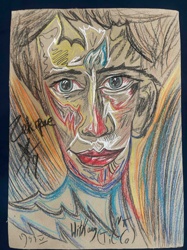
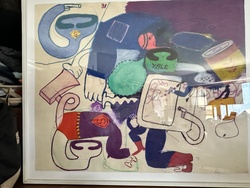
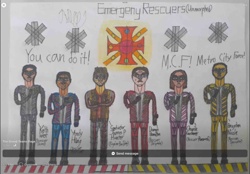
AI estimate as of November 8, 2025 · verify with a professional before acting
AI-Generated · Verify before acting
Everything on this page is generated by AI for informational purposes only. AI can make mistakes — the AI may misidentify items or misattribute them (artist, maker, brand, designer, origin, era). This is not an official valuation and should not be used for insurance, sale, tax, estate, legal, or lending purposes — or any decision requiring a certified appraisal. It is not an authoritative claim about any person, brand, or rights holder — do not share or rely on it as a factual statement about a third party. Always consult qualified professionals before making financial decisions.
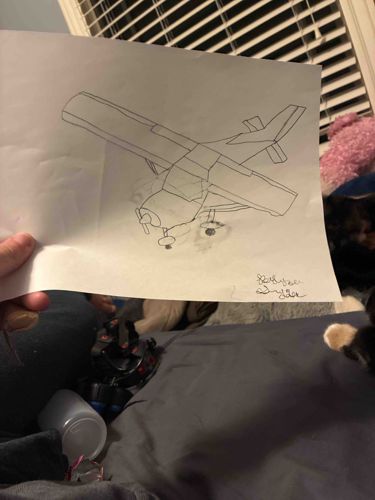
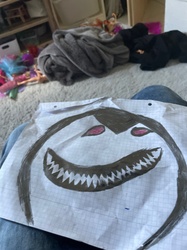
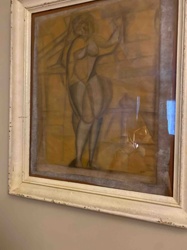
This item is a hand-drawn pencil sketch depicting a single-engine, high-wing propeller airplane viewed from a three-quarter angle from below and slightly to the front. The drawing is executed on a sheet of plain white paper, which appears to be standard printer or drawing paper, exhibiting some minor creases and soft folds consistent with handling. The physical characteristics indicate a relatively small artwork, likely on an A4 or letter-sized sheet, with visible edges of the paper suggesting it has been held. The drawing itself is rendered in a monochromatic palette using what appears to be a graphite pencil or possibly a fine-tipped black pen, given the consistent line weight. The airplane features a visible propeller at the front, conventional landing gear with two main wheels under the wings and a smaller wheel or skid near the tail, and a standard tail configuration with horizontal and vertical stabilizers. The wings are flat and straight, typical of many light aircraft designs. Details such as cockpit windows are suggested by lines, but no specific interior details are visible. The craftsmanship shows a basic to intermediate level of drawing skill, with clear outlines and an understanding of perspective, although some parts, like the landing gear, appear less refined than the main body and wings. There are visible squiggles and light pencil marks around certain areas, possibly from initial sketching or erasing. A signature or inscription is present in the lower right quadrant of the paper, written in cursive script, though it is not clearly legible from the image provided. The visible condition issues are minor, limited to the aforementioned creases and potentially some light smudging typical of pencil drawings. There are no major tears, stains, or significant damage. This piece appears to be a unique, original drawing rather than a print or reproduction. The style is illustrative and technical, focusing on the form of the aircraft. Given its hand-drawn nature and lack of advanced shading or detail, it is likely a practice sketch, a concept drawing, or a casual piece of art, possibly created by an amateur artist or student. The estimated age is recent, consistent with modern paper and drawing tools.
AI Appraisal Report
I have examined the provided image of this hand-drawn pencil sketch of a propeller airplane. Based on my visual assessment, the item's condition is fair to good, exhibiting minor creases and soft folds consistent with handling, and light smudging typical of pencil drawings. There are no major tears or stains visible, suggesting it has been reasonably well-preserved for a casual sketch. Its authenticity as an original hand-drawn piece is strongly indicated by the visible pencil marks, squiggles, and less refined areas, which are inconsistent with a reproduction. The presence of a cursive signature further supports its originality, though legibility is an issue.
Market conditions for original, unsigned, or an amateur pencil sketches are generally modest. Comparable items, typically by unknown or amateur artists, often sell in the low double-digit to low triple-digit range, primarily to aviation enthusiasts or for decorative purposes. The demand for such a piece is limited by its lack of provenance, the absence of a recognized artist, and its basic to intermediate artistic skill level. It is not rare; similar aviation sketches are relatively common. Factors significantly impacting its value include the unknown artist and the primary function as a practice or casual sketch rather than a finished work of art.
Limitations in authenticity verification from images alone are significant. While it strongly appears to be an original sketch, without an in-person examination, I cannot definitively confirm the medium (graphite vs. fine-tipped pen) or rule out advanced printing techniques with absolute certainty, though this is highly unlikely. Full authentication would require physical inspection to examine paper fibers, pencil pressure, and signature details under magnification, as well as provenance documentation to identify the artist and establish its history. Scientific testing, such as carbon dating on the paper, could confirm age but is unnecessary for a piece of this estimated value and recent origin. Without clear artist identification or a compelling story, its value remains primarily as an original, decorative, amateur aviation drawing.