AI estimate as of August 18, 2025 · verify with a professional before acting
AI-Generated · Verify before acting
Everything on this page is generated by AI for informational purposes only. AI can make mistakes — the AI may misidentify items or misattribute them (artist, maker, brand, designer, origin, era). This is not an official valuation and should not be used for insurance, sale, tax, estate, legal, or lending purposes — or any decision requiring a certified appraisal. It is not an authoritative claim about any person, brand, or rights holder — do not share or rely on it as a factual statement about a third party. Always consult qualified professionals before making financial decisions.
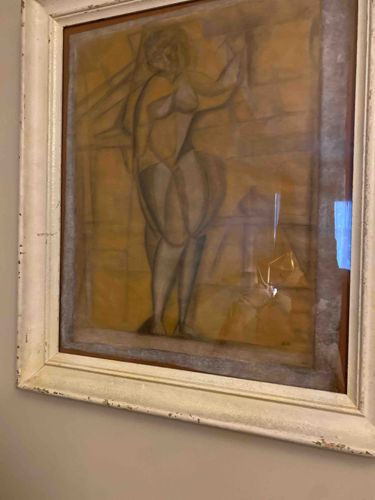
This item is a framed piece of artwork, likely a drawing or charcoal sketch, depicting a stylized female figure. The figure is rendered with strong angular lines and geometric shapes, reminiscent of Cubist or Futurist artistic styles, particularly in the treatment of the face, limbs, and torso. The primary colors used are shades of grey or charcoal for the figure against what appears to be a warm, a ochre or light brown background, possibly aged paper or a toned ground. The artwork is housed within a light-colored, possibly off-white or cream-colored, wooden frame. The frame exhibits a distressed or 'shabby chic' finish, with visible chips, scuffs, and areas where the paint appears to be intentionally worn, revealing darker undertones or the wood beneath. This suggests either an antique finish or a reproduction designed to look aged. The artwork is protected by a sheet of glass, which shows significant reflections and some distortion, making it difficult to discern fine details or any potential signatures or markings in the lower right portion of the artwork. There is also a notable glare in the bottom right corner, obscuring part of the image. The overall condition of the frame suggests age or deliberate distressing. The artwork itself, behind the glass, appears to be in reasonable condition, though its exact state cannot be fully assessed due to the reflections and visual obstructions. Based on the artistic style, the estimated age could be early to mid-20th century, particularly aligning with modern art movements from the 1910s to 1950s. The craftsmanship of the drawing lies in its bold abstraction and geometric simplification, demonstrating a clear artistic intention behind the composition.
AI Appraisal Report
Upon visual examination of the provided image, I assess this framed Cubist-style female nude drawing. The artwork exhibits strong angularity and geometric forms characteristic of early to mid-20th century modern art, likely between the 1910s and 1950s. The choice of charcoal or similar medium on a warm-toned ground is visually appealing and consistent with the period. The distressed frame, while fitting the aesthetic, appears to be a 'shabby chic' finish, which could be contemporary or intentionally aged, rather than original to the artwork's creation. Its condition, with visible scuffs and chips, suggests either age or deliberate styling.
My assessment of authenticity is limited by the visual information. The reflections and glare on the glass obscure crucial details, particularly in the lower right, preventing any verification of a signature or artist's mark. Without clear provenance documentation or a professional in-person examination, definitive attribution is impossible. The market for unsigned or unattributed cubist-style drawings varies significantly. While the artistic merit and composition are evident, the lack of an identifiable artist greatly impacts value.
Comparable sales of unattributed period works of this caliber might range from a few hundred to a couple of thousand dollars, depending on medium, size, and perceived quality. If this work were attributed to a known artist, even a minor one, the value could increase exponentially. Demand for Cubist aesthetics remains steady, but rarity is challenging to determine without knowing the artist or whether it's a unique work versus a study by a student.
Limitations in authenticity verification from images alone are significant. A physical inspection is crucial to assess the paper type, medium application, and search for faint inscriptions or watermarks. Furthermore, provenance documentation (e.g., bills of sale, exhibition history) is essential. Scientific testing, such as pigment analysis or carbon dating, could further ascertain age and material authenticity. Without these, my appraisal is based purely on the aesthetic quality of what is visible.
Based on these factors, and acknowledging the significant limitations in authentication via image alone, I estimate the value to be in the lower-to-mid range for an attractive, yet unattributed, period piece of this style.