AI estimate as of July 18, 2025 · verify with a professional before acting
AI-Generated · Verify before acting
Everything on this page is generated by AI for informational purposes only. AI can make mistakes — the AI may misidentify items or misattribute them (artist, maker, brand, designer, origin, era). This is not an official valuation and should not be used for insurance, sale, tax, estate, legal, or lending purposes — or any decision requiring a certified appraisal. It is not an authoritative claim about any person, brand, or rights holder — do not share or rely on it as a factual statement about a third party. Always consult qualified professionals before making financial decisions.
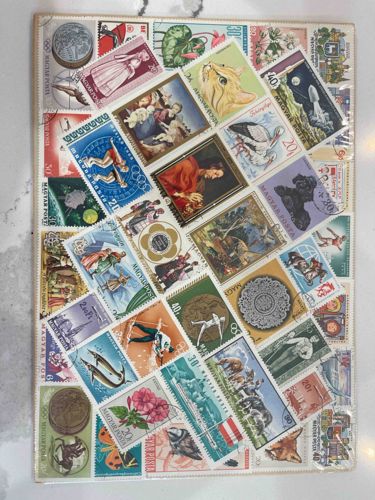
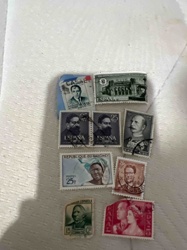
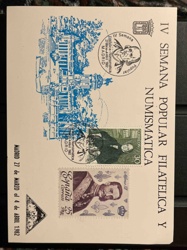
This item is a decorative wall hanging or framed art piece composed entirely of numerous postage stamps, primarily from Hungary ('MAGYAR POSTA'). The stamps are arranged in a dynamic, overlapping, and seemingly random collage pattern, creating a rich tapestry of colors and imagery. The overall dimensions appear to be rectangular, likely common picture frame sizes, judging from the visible edges and proportional elements. The individual stamps feature a wide array of subjects, including historical figures (a woman in a pink period dress), animals (a cat, a fox, birds, fish, bears, various mammals), Olympic sports (swimming, diving, figure skating, discus throw), famous paintings (likely Old Masters), landscapes (mountains, trees, water scenes), abstract patterns, and architectural designs (e.g., the Parliament Building in Budapest). Some stamps show specific denominations like '20 f', '30 f', and '40 f'. The color palette is very diverse, reflecting the various stamp designs, ranging from vibrant blues, greens, reds, and yellows to more muted earth tones. The stamps appear to be in generally good condition, though some might have minor creasing or slight discoloration inherent to their age and original use, as well as potential minor wear from being handled prior to assembly. There are no obvious signs of significant damage, tears, or repairs to the stamps themselves. The arrangement is held together, likely mounted on a flat board and possibly protected by a clear plastic or glass sheet, indicated by the slight sheen and visible edge of a protective layer. The style suggests a mid to late 20th-century aesthetic, common for decorative stamp collages, and the 'MAGYAR POSTA' markings confirm origin. The craftsmanship involves careful selection and artistic placement of the stamps to create a visually appealing, albeit informal, composition.
AI Appraisal Report
Upon visual examination of this Hungarian Postage Stamp Collage, I assess its condition as good, consistent with a decorative art piece of its type. The individual stamps, primarily 'MAGYAR POSTA' issues, appear well-preserved within the collage, showing no significant tears or major damage, only minor wear consistent with their age and artistic application. Authenticity of the stamps themselves as genuine Hungarian issues is strongly supported by the visible 'MAGYAR POSTA' markings and typical designs from mid-to-late 20th-century philately. However, without physical inspection, I cannot confirm if all stamps are genuinely used or new old stock, nor can I verify any potential repairs or alterations that might be hidden by the collage arrangement from a surface-level photograph. The artistic arrangement is typical of decorative stamp collages, a popular craft in the latter half of the 20th century. Market conditions for such 'philatelic art' are niche, driven more by aesthetic appeal and decorative value than by the intrinsic philatelic value of individual stamps. While some stamps might hold minor individual value, their arrangement into a collage generally diminishes their collectibility from a traditional philatelic standpoint. Demand is limited, primarily from individuals seeking unique wall art or those with a personal connection to Hungary or philately. Rarity is low; similar collages are not uncommon, though the specific selection and arrangement of stamps make each piece unique. Factors significantly impacting value include the overall aesthetic appeal, quality of craftsmanship in assembly, and the condition of the protective framing/mounting. The presence of a clear protective layer suggests greater care in preservation. Without physical examination, I cannot comment on the mounting method (acid-free, etc.), nor can I verify the material or quality of any unseen frame. Full authentication would require in-hand inspection to verify individual stamp authenticity, assess hidden condition issues, and evaluate the quality of materials used for mounting and potential framing.