AI estimate as of November 30, 2025 · verify with a professional before acting
AI-Generated · Verify before acting
Everything on this page is generated by AI for informational purposes only. AI can make mistakes — the AI may misidentify items or misattribute them (artist, maker, brand, designer, origin, era). This is not an official valuation and should not be used for insurance, sale, tax, estate, legal, or lending purposes — or any decision requiring a certified appraisal. It is not an authoritative claim about any person, brand, or rights holder — do not share or rely on it as a factual statement about a third party. Always consult qualified professionals before making financial decisions.
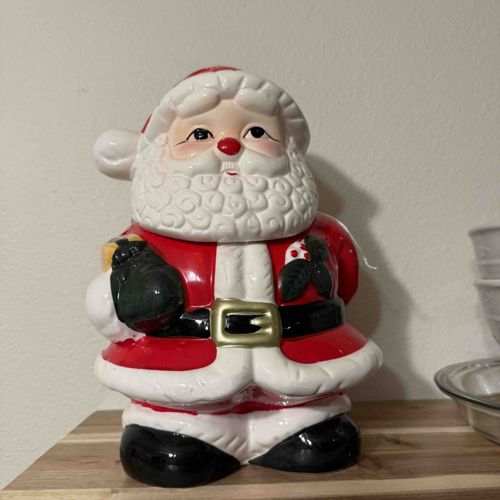
This is a figural ceramic cookie jar, meticulously crafted in the likeness of Santa Claus. The item is composed of glazed ceramic, featuring a vibrant color palette dominated by classic Christmas red, white, black, and gold accents. Santa's suit, including his coat and pants, is a deep glossy red, contrasted by fluffy white trim on his hat, beard, mustache, and the cuffs and bottom of his outfit, suggesting a snowy texture. His face is painted with a soft pinkish-peach tone, accented with rosy cheeks, a red nose, and black eyes. His flowing white beard and mustache are rendered with a sculpted, textured detail, indicating individual curls or waves. He wears black boots and a wide black belt with a prominent rectangular gold buckle. A green bag or sack is depicted clutched in his left arm, and on his right lapel, there is a small sprig of holly with red berries, adding a festive touch. The cookie jar is constructed in two main pieces: the upper body, encompassing Santa's head and torso down to his waist, which serves as the lid, and the lower body, including his legs and boots, forming the base. The seams where the lid meets the base are subtly incorporated into the design, specifically around Santa's mid-section, just above his belt buckle. The glaze appears consistent and shiny across the entire surface, suggesting good quality and preservation. There are no immediately obvious chips, cracks, or significant wear visible from the provided images, indicating it is in good to excellent condition. The style is traditional and festive, likely dating from the mid to late 20th century, common for holiday-themed ceramic kitchenware. The craftsmanship appears to be of standard commercial quality for novelty ceramic items, with hand-painted details adding character.
AI Appraisal Report
Upon visual examination of the provided image, I assess this Ceramic Santa Claus Cookie Jar to be in good to excellent condition. The consistent, shiny glaze, lack of visible chips, cracks, or significant wear suggests it has been well-preserved. Authenticity as a period novelty item is supported by the traditional design and apparent manufacturing quality consistent with mid to late 20th-century ceramic kitchenware. However, without a maker's mark, stamp, or signature, definitive attribution to a specific manufacturer or precise dating is not possible from images alone. A physical inspection would allow me to check for such markings and examine the underside of the base and lid lip for any subtle imperfections or wear not visible here.
The market for novelty ceramic cookie jars, particularly Santa Claus themed items, is generally stable but not characterized by high values. Comparables in similar condition from the mid-to-late 20th century typically sell in the $25-$75 range. Demand tends to be seasonal, peaking before and during the Christmas holidays. This item does not appear to be exceptionally rare or from a highly collectible manufacturer, which would significantly impact its value. Factors influencing value here are primarily its excellent condition, festive appeal, and functional utility, offset by its commonality in the collector's market. Any unique marks or provenance documentation (e.g., original packaging, sales receipts from a specific era) would be needed to potentially increase its value beyond this estimated range. Scientific testing is not typically applied to these types of items for authentication or dating.