AI estimate as of October 11, 2025 · verify with a professional before acting
AI-Generated · Verify before acting
Everything on this page is generated by AI for informational purposes only. AI can make mistakes — the AI may misidentify items or misattribute them (artist, maker, brand, designer, origin, era). This is not an official valuation and should not be used for insurance, sale, tax, estate, legal, or lending purposes — or any decision requiring a certified appraisal. It is not an authoritative claim about any person, brand, or rights holder — do not share or rely on it as a factual statement about a third party. Always consult qualified professionals before making financial decisions.
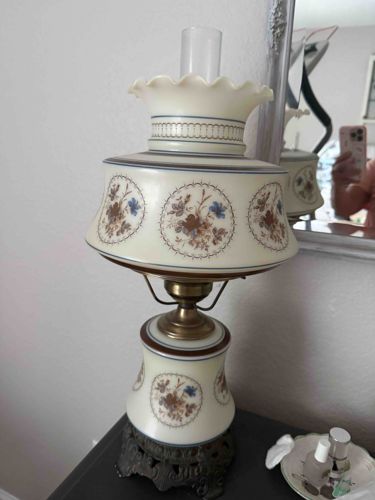
This is a vintage hurricane-style table lamp, primarily constructed from milk glass with brass and cast metal accents. The overall color scheme is cream/off-white for the glass, complemented by dark blue, brown, and light blue floral decals. The lamp features a two-piece milk glass design: an upper, ruffled-edge shade that tapers downwards, and a bulbous lower base. Both sections of the milk glass are adorned with a repeating pattern of circular medallions, each containing a delicate floral arrangement in shades of brown, dark blue, and light blue, set against a background of thin, intricate brown lines. A distinctive scalloped border in dark blue outlines these medallions. Additional decorative banding, comprising interconnected ovals or scallops, encircles the base of the upper shade and the neck of the lower base in dark blue and brown tones. The upper shade also contains a clear glass chimney, typical of hurricane lamps, extending above the ruffled edge. \n\nThe milk glass sections are joined by a brass-toned metal fixture, which also supports the upper shade. The base of the lamp is a dark, possibly bronzed or cast iron, ornate pedestal with a textured, almost antique finish, showing some visible patina and wear consistent with age, suggesting it is a cast metal piece. The condition of the milk glass appears good, with no obvious cracks or chips visible from the provided image. The presence of the clear glass chimney indicates it functions as an electric lamp, designed to mimic the aesthetic of an oil lamp. The style suggests a mid-20th century Americana or traditional decor piece, likely from the 1950s-1970s. The craftsmanship is indicative of mass-produced decorative lighting of that era, with attention to detail in the decaling and the decorative metal base. No visible manufacturer's marks or signatures are discernible from the image.
AI Appraisal Report
I have examined the provided image of this Vintage Milk Glass Hurricane Table Lamp with Floral Decals. Based on my visual assessment, the lamp appears to be in good overall condition, with the milk glass free from apparent chips or cracks. The dark metal base shows expected patination and wear consistent with its age, which adds to its vintage aesthetic. Authenticity is supported by its design elements, which align with mid-20th century mass-produced decorative lighting from the 1950s-1970s. The floral decals and hurricane style are characteristic of Americana or traditional decor of that period.
Market conditions for vintage decorative lamps like this are generally moderate. While milk glass items have a consistent following, this particular style and commonality of mass production mean it's not a rare piece. Comparable items in similar condition on platforms like eBay or Etsy typically range from $40 to $150, with higher values for lamps in pristine condition or with more unique designs. Demand is niche; it appeals to collectors of vintage home decor or those furnishing period-specific interiors. Factors significantly impacting value include the good condition of the glass and the completeness of the lamp with its clear chimney. However, the lack of a known manufacturer or any discernible unique features limits its top-tier value.
Limitations in authenticity verification from an image alone are considerable. I cannot assess the functionality of the electrical components, internal wiring, or the true material composition of the metal base (e.g., whether it's cast iron, pot metal, etc.). A physical examination would allow me to check for unseen damage, assess the quality of the finish more accurately, and search for hidden manufacturer’s marks. Provenance documentation would confirm its precise age and origin, but is rarely available for such mass-produced decorative items.