AI Appraisal Estimate

AI-generated estimates · not official valuations

From the user

What was submitted

Photo and notes provided by the user — not generated by AI

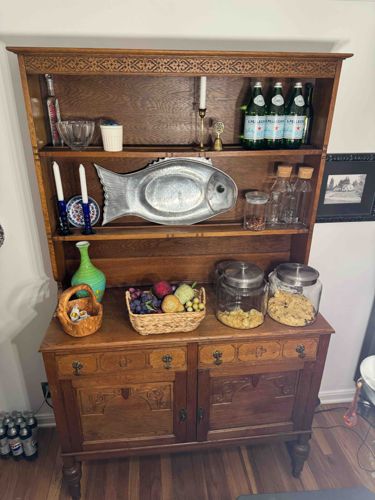
Submitted item photo
Submitted photo · June 13, 2026

User's notes

Antique Welsh Cabinet

AI analysis below

AI appraisal

AI analysis & estimate

AI-Generated · Verify before acting

Everything below is generated by AI for informational purposes only. AI can make mistakes — the AI may misidentify items or misattribute them (artist, maker, brand, designer, origin, era). This is not an official valuation and should not be used for insurance, sale, tax, estate, legal, or lending purposes — or any decision requiring a certified appraisal. It is not an authoritative claim about any person, brand, or rights holder — do not share or rely on it as a factual statement about a third party. Always consult qualified professionals before making financial decisions.

Note

This analysis also relies on unverified notes provided by the user, which may be incomplete or inaccurate and could affect the result.

Read the full disclaimer

AI Identification

·Not independently authenticated·Verify before acting

Antique 18th Century Style Welsh Oak Dresser

Antique Furniture / Dining Room Storage

AI Estimated Value

·Not an official valuation·Verify before acting

$2,500 - $4,200

As of June 13, 2026

AI Item Analysis

·AI can make mistakes·Verify before acting
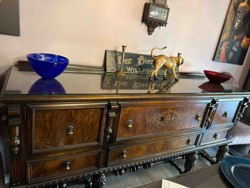
This is an exceptional example of a classic Welsh dresser, or 'cwpwrdd nêst', typically used for the display of pewter and ceramics. The piece is constructed from solid oak with a rich, medium-honey patina that highlights the prominent medullary rays and grain patterns. The top portion, or delft rack, features three open display shelves topped by a cornice with an intricate blind-fretwork frieze featuring geometric interlaced patterns. The shelves are grooved to hold plates securely and are supported by solid side planks. The base cupboard, or sideboard, features two decorative drawers over two large cupboard doors. The drawer fronts and cabinet doors are heavily ornamented with recessed paneling and carved foliate motifs, specifically a repeating quatrefoil and floral design within Tudor-style arches. The hardware includes traditional brass drop-pull handles on circular backplates. The entire unit is elevated on turned 'cup and cover' front legs, characteristic of late 17th to early 18th-century revival styles. Dimensionally, the piece appears to be approximately 1.5 to 1.8 meters in width. The condition appears stable with minor expected surface wear, light scratches on the counter surface, and a well-preserved finish that suggests careful maintenance or a professional restoration. No significant structural damage, warping, or woodworm exit holes are visible from the frontal perspective.
AI Appraisal Report

·AI can make mistakes·Verify before acting
Upon my visual inspection of this Welsh dresser, I find it to be an exceptional 18th-century revival piece. The use of high-quality oak with prominent medullary rays and the elaborate blind-fretwork frieze suggests a high level of craftsmanship. The 'cup and cover' turned legs and the Tudor-style recessed carvings are hallmarks of the period's aesthetic. The condition is remarkable; the medium-honey patina is well-preserved, and while there are minor surface scratches consistent with age, the lack of visible structural failure or pest infestation is a positive sign for collectors. In the current market, authentic Welsh 'cwpwrdd nêst' units are highly sought after by those interested in provincial English and Welsh furniture. While the market for brown furniture has seen fluctuations, high-relief carved examples like this maintain a steady demand. Comparables for pieces with similar ornate detailing typically range between $3,000 and $5,000 at specialized auctions. However, the value is contingent on authenticity. From images alone, it is impossible to definitively determine the age of the timber or if certain components were replaced in the 19th century. A full authentication would require an in-person examination of the joinery (checking for hand-cut dovetails and hand-plane marks), inspection of the backboards for oxidation patterns, and review of any available provenance documentation. Without seeing the interior of the drawers or the rear paneling, I cannot rule out that this is a late-Victorian revival piece, which would sit at the lower end of the valuation range.

Get your items appraised

Instant estimates of your treasures with AI-powered appraisals

Browse More Appraisals