AI estimate as of November 15, 2025 · verify with a professional before acting
AI-Generated · Verify before acting
Everything on this page is generated by AI for informational purposes only. AI can make mistakes — the AI may misidentify items or misattribute them (artist, maker, brand, designer, origin, era). This is not an official valuation and should not be used for insurance, sale, tax, estate, legal, or lending purposes — or any decision requiring a certified appraisal. It is not an authoritative claim about any person, brand, or rights holder — do not share or rely on it as a factual statement about a third party. Always consult qualified professionals before making financial decisions.
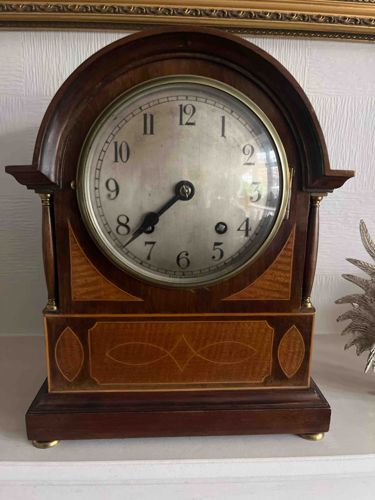
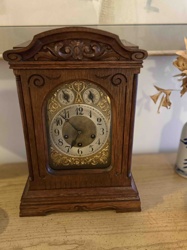
This is a handsome Aesthetic Movement mantle clock, likely dating from the late 19th or early 20th century. The clock features a dark stained wooden case, possibly mahogany or walnut, with a distinct arched top and a rectangular base. The wood exhibits a rich, deep brown color with visible grain, suggesting a quality timber. The front of the case is adorned with intricate veneering and inlay work, showcasing tiger oak or highly figured maple panels with lighter wood stringing that forms geometric patterns, including stylized ovals and a central criss-cross or knot design. These decorative elements are characteristic of the Aesthetic Movement, emphasizing natural materials and craftsmanship. The dial is a classic silvered or cream-colored metallic face with clear black Arabic numerals, framed by a brass bezel. The hands are black, spade-shaped, and appear to be original. A winding hole is visible to the right of the '4' numeral. The overall condition appears good for its age, showing a consistent patina on the wood. There may be some light surface scratching or minor wear consistent with age and use, but no major cracks or repairs are immediately evident from the image. The brass elements, including the bezel and the small decorative feet or finials at the corners of the base, show some oxidation or age-related dullness, which is expected. The clock stands on four small brass bun feet, which elevate the piece from the surface. The construction suggests a well-made, domestic timepiece, indicating a functional and decorative item designed to be a focal point in a living space.
AI Appraisal Report
Upon my virtual examination of this Aesthetic Movement mantle clock, I observe a well-preserved piece likely from the late 19th to early 20th century. The dark-stained wooden case, possibly mahogany or walnut, exhibits an attractive patina consistent with its age. The intricate veneering and inlay, featuring tiger oak or figured maple panels with lighter wood stringing in geometric patterns, are characteristic of the Aesthetic Movement’s emphasis on natural materials and craftsmanship. The silvered or cream-colored metallic dial with clear Arabic numerals and original spade hands, framed by a brass bezel, appears complete. The overall condition looks good for its age; I note some expected surface wear and potential oxidation on the brass elements, but no obvious major damage, cracks, or repairs are discernible from the image. Its construction suggests a well-made domestic timepiece.
Market conditions for Aesthetic Movement clocks are steady but not experiencing rapid growth. Comparable clocks in similar condition with striking movements typically fetch higher prices. This piece, being a time-only clock (based on the single winding hole visible), would fall into a more accessible price range. Demand is from collectors and individuals seeking period decorative items. Rarity is moderate; while not unique, well-preserved examples with appealing inlay work are always desirable.
Factors significantly impacting value include the single winding hole suggesting a time-only movement, which generally commands less than a time-and-strike mechanism. The quality of the inlay and the overall preservation of the original finish are positive value drivers.
It is crucial to note the limitations of image-based appraisal. Without a physical inspection, I cannot definitively determine the wood species, the mechanical condition of the movement (e.g., if it runs, keeps time, or needs service), or the full extent of any subtle repairs or restorations. An in-person examination would allow for inspection of the movement, verification of any maker's marks, assessment of the internal condition of the case, and detailed analysis of the wood and inlay. Provenance documentation would further confirm authenticity and origin. Scientific testing might be needed to confirm wood types definitively or to detect modern interventions if suspicions arose.