AI estimate as of October 24, 2025 · verify with a professional before acting
AI-Generated · Verify before acting
Everything on this page is generated by AI for informational purposes only. AI can make mistakes — the AI may misidentify items or misattribute them (artist, maker, brand, designer, origin, era). This is not an official valuation and should not be used for insurance, sale, tax, estate, legal, or lending purposes — or any decision requiring a certified appraisal. It is not an authoritative claim about any person, brand, or rights holder — do not share or rely on it as a factual statement about a third party. Always consult qualified professionals before making financial decisions.
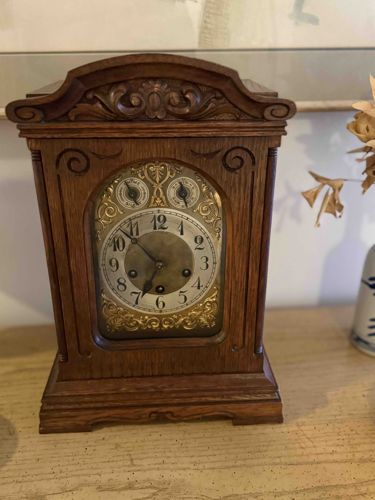
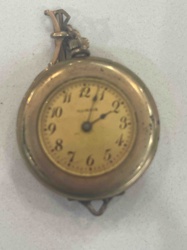
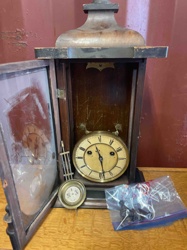
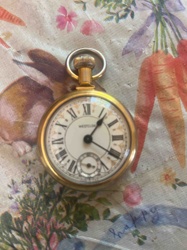
This is an antique mantle clock, likely of American or European origin, featuring a traditional rectangular form with a gently curved and ornate top. The clock is constructed from dark-stained wood, possibly oak or a similar hardwood, exhibiting a visible grain pattern. The overall finish appears to be a rich, medium-brown tone. The most prominent decorative elements are found on the top and face of the clock. The top features carved scrollwork and floral motifs, adding an elegant touch. The clock face is set within a brass or gilt metal bezel with intricate embossed or cast ornamentation, showing an almost Gothic or Art Nouveau-inspired design around the circular dial. The dial itself is cream or off-white with black Arabic numerals, and what appear to be two smaller subsidiary dials or indicators above the main dial, possibly for chime settings like 'strike/silent' or 'chime melodies,' although the specific functions are not clearly discernible from the image. The hands are dark and slender, contrasting well with the light dial. The glass crystal covering the face is clear. The case itself shows some signs of age, including minor scuffs or wear marks on the wood, consistent with an item of its presumed age. The craftsmanship appears to be of good quality, with attention to detail in the carvings and metalwork. This style points to a late 19th to early 20th-century manufacturing period, likely between 1890 and 1930. The base is sturdy and recessed on its underside, allowing the clock to sit firmly.
AI Appraisal Report
Upon visual examination of this antique chime mantle clock, I assess its condition to be good, consistent with an item of its presumed age, likely late 19th to early 20th century (1890-1930). The dark-stained wood case, possibly oak, presents a rich medium-brown tone with visible grain. Minor scuffs and wear marks are visible, which is expected for an item of this vintage and does not significantly detract from its aesthetic appeal. The carved scrollwork and floral motifs on top, along with the ornate brass/gilt metal bezel with its Gothic/Art Nouveau-inspired ornamentation, are well-preserved and indicate good craftsmanship. The cream dial with clear black Arabic numerals and contrasting dark hands is intact. The two subsidiary dials suggest chime functionality, enhancing its appeal. The clear glass crystal is a positive. Authentication of origin (American or European) and specific manufacturer is difficult without in-person inspection of the movement, case markings, and internal components.
Market conditions for antique mantle clocks of this type are generally stable but not experiencing significant surges in demand. Comparables typically fall within a broad range based on manufacturer, rarity, condition, and chime complexity. While aesthetically pleasing, this clock does not display unique or exceedingly rare features that would command a premium. Demand is moderate among collectors and those seeking period decorative items. Factors impacting value positively include its complete appearance, decorative appeal, and presumed chime function. Negatively, the lack of a prominent, highly collectible maker's mark and the absence of unique materials or design elements limit its top-tier value.
Limitations in authenticity verification from images alone are significant. Full authentication would necessitate an in-person examination to inspect the clock's movement for maker's marks, serial numbers, and condition; assess the wood species and construction methods definitively; and confirm the operational status of the chime mechanism. Provenance documentation, if available, would significantly enhance its historical value. Scientific testing is generally not required for this type of item unless there are specific questions regarding material composition not evident visually.