AI estimate as of July 11, 2025 · verify with a professional before acting
AI-Generated · Verify before acting
Everything on this page is generated by AI for informational purposes only. AI can make mistakes — the AI may misidentify items or misattribute them (artist, maker, brand, designer, origin, era). This is not an official valuation and should not be used for insurance, sale, tax, estate, legal, or lending purposes — or any decision requiring a certified appraisal. It is not an authoritative claim about any person, brand, or rights holder — do not share or rely on it as a factual statement about a third party. Always consult qualified professionals before making financial decisions.
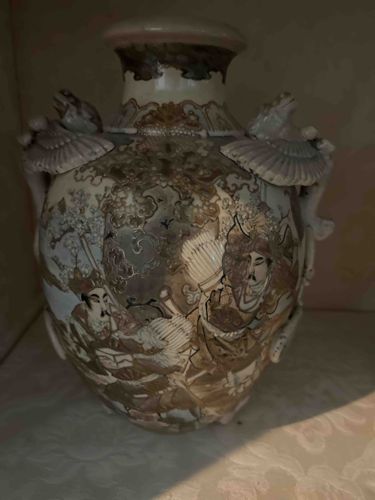
This appears to be an antique or vintage Japanese Satsuma-style earthenware vase, characterized by its elaborate hand-painted decoration and often gilt accents. The vase has a globular body tapering towards a flared neck and a wide mouth. Its primary color scheme involves muted pastels and earth tones, including creams, light blues, browns, and subdued reds, with significant use of gold gilding to highlight details and patterns. A notable feature is the presence of three-dimensional applications or handles on the shoulders of the vase, resembling mythical creatures or birds with outstretched wings and possibly frog-like figures perched on top. The main body of the vase is densely decorated with detailed figural scenes, likely depicting historical or mythological Japanese figures in traditional attire, often in interior or garden settings. The painting style exhibits fine brushwork, typical of Satsuma ware, with intricate patterns and delicate facial features on the figures. There also appear to be areas with raised enamel or moriage decoration, adding textural interest. Visible condition issues include a likely aged patina, and given its probable age, minor wear to the gilding or surface might be present, though not clearly discernible from the provided image. The overall craftsmanship suggests a high level of artistic skill. The detailed decoration and sculptural elements point to a Meiji period (1868-1912) or early 20th-century origin, a time when Satsuma ware was highly sought after for export. No specific maker's marks are visible in the provided image.
AI Appraisal Report
Based on my visual examination of the provided image, this Japanese Satsuma ware vase presents as a finely crafted example from the Meiji period (1868-1912) or early 20th century. My assessment of its condition, given the visual information, is good; the colors appear vibrant, and the extensive gilding seems largely intact, though minor wear, typical for its age, is to be expected. The intricate figural scenes and the substantial applied mythical creatures demonstrate high-quality artistic skill, a hallmark of desirable Satsuma pieces. The rich detail and heavy gilding suggest it was intended for the export market, where such elaborate decoration was highly prized.
From a market perspective, Satsuma ware, particularly pieces with detailed figural work and three-dimensional applications, continues to attract collectors. Demand remains steady for exceptional examples, especially those free from significant damage like chips, cracks, or substantial gilding loss. This piece's rarity is enhanced by the sculptural elements and the presumed high level of artistry in the painting. Factors significantly impacting value include the overall artistic quality, condition, complexity of decoration, and the presence of any artist's or workshop marks (though none are discernible here).
It is crucial to note the limitations of authenticating from images alone. While this piece strongly resembles genuine Satsuma, tactile examination is essential to confirm the earthenware body, detect any restorations, assess the exact quality of the enamels and gilding, and verify the moriage application. Microscopic examination could confirm pigment age. Provenance documentation, such as prior ownership or exhibition history, would further solidify authenticity. Without physical inspection, I cannot definitively confirm every aspect of its authenticity or condition; my assessment is based solely on what the image conveys.