AI Appraisal Estimate

AI-generated estimates · not official valuations

From the user

What was submitted

Photo and notes provided by the user — not generated by AI

Submitted item photo
Submitted photo · June 20, 2026

User's notes

No additional notes provided.

AI analysis below

AI appraisal

AI analysis & estimate

AI-Generated · Verify before acting

Everything below is generated by AI for informational purposes only. AI can make mistakes — the AI may misidentify items or misattribute them (artist, maker, brand, designer, origin, era). This is not an official valuation and should not be used for insurance, sale, tax, estate, legal, or lending purposes — or any decision requiring a certified appraisal. It is not an authoritative claim about any person, brand, or rights holder — do not share or rely on it as a factual statement about a third party. Always consult qualified professionals before making financial decisions.

Read the full disclaimer

AI Identification

·Not independently authenticated·Verify before acting

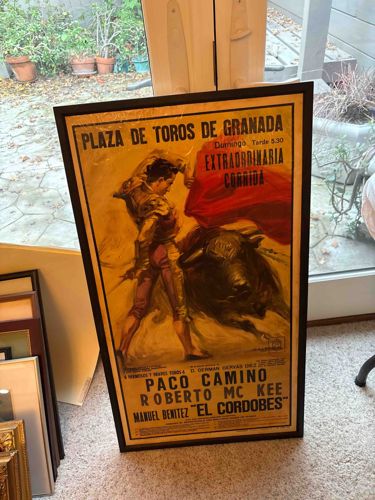
Vintage Plaza de Toros de Granada Bullfighting Poster

Vintage Advertisements and Posters

AI Estimated Value

·Not an official valuation·Verify before acting

$150-$250

As of June 20, 2026

AI Item Analysis

·AI can make mistakes·Verify before acting
This is a vintage promotional poster for a bullfighting event at the Plaza de Toros de Granada in Spain. The artwork features a dramatic central illustration of a matador in traditional trajes de luces attire, holding a muleta (red cape) while engaging with a charging bull. The graphic design utilizes a warm, sepia-toned background that suggests significant age or a deliberate vintage aesthetic. The text lists prominent matadors of the era, including Paco Camino, Roberto McKee, and Manuel Benitez 'El Cordobes,' suggesting a mid-20th-century origin, likely from the 1960s or 1970s. The poster is housed in a simple, slim dark wood or black composite frame under protective glass. Physically, the paper shows signs of yellowing/toning and visible horizontal creases, indicating it may have been folded at some point before framing. There is a discernible 'Extraordinaria Corrida' headline in bold red lettering. The lithographic quality appears consistent with mid-century mass production for tourist souvenirs or local event promotion. The condition shows moderate patina with some surface irregularities, but the overall image remains vibrant and legible.

AI Appraisal Report

·AI can make mistakes·Verify before acting
I have conducted a visual examination of the vintage Plaza de Toros de Granada poster. Based on the typography and the appearance of legendary matadors Paco Camino and 'El Cordobes,' this piece dates to the mid-1960s—a 'golden age' for bullfighting tourism in Spain. The sepia-toned paper displays authentic aging through uniform toning and prominent horizontal crease lines, suggesting it was originally folded for distribution as a localized promotional broadside or souvenir. The condition is fair-to-good; while the creases and paper yellowing indicate significant exposure, they also lend to the 'vintage' aesthetic currently favored by collectors of Spanish memorabilia. The market for mid-century Bullfighting posters is stable but saturated with modern reprints. Original lithographs or early mass-production pieces featuring marquee names like El Cordobes command a modest premium. Comparables for framed examples of this size and era typically hammer between $100 and $300 at specialized ephemera auctions. The current framing provides aesthetic value but limits my ability to inspect the edges for moisture damage or acidic tape residue. Important Note: This appraisal is based on photographic evidence. A definitive authentication requires an in-person examination to verify paper weight, ink absorption, and the presence of a printers' mark or lithographic dot patterns to distinguish this from late-20th-century reproductions. To elevate the valuation, provenance regarding its original acquisition at the Granada bullring or evidence that it is a stone-lithograph rather than an offset-mechanical print would be necessary. Physical inspection should also confirm if the paper is laid or wove, which would more accurately pinpoint the production technique and date.

Get your items appraised

Instant estimates of your treasures with AI-powered appraisals

Browse More Appraisals