AI Appraisal Estimate

AI-generated estimates · not official valuations

From the user

What was submitted

Photo and notes provided by the user — not generated by AI

Submitted item photo
Submitted photo · June 13, 2026

User's notes

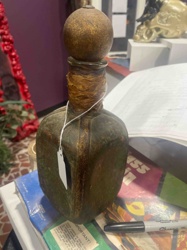
Crystal decanter - vintage ~ 1950’s

AI analysis below

AI appraisal

AI analysis & estimate

AI-Generated · Verify before acting

Everything below is generated by AI for informational purposes only. AI can make mistakes — the AI may misidentify items or misattribute them (artist, maker, brand, designer, origin, era). This is not an official valuation and should not be used for insurance, sale, tax, estate, legal, or lending purposes — or any decision requiring a certified appraisal. It is not an authoritative claim about any person, brand, or rights holder — do not share or rely on it as a factual statement about a third party. Always consult qualified professionals before making financial decisions.

Note

This analysis also relies on unverified notes provided by the user, which may be incomplete or inaccurate and could affect the result.

Read the full disclaimer

AI Identification

·Not independently authenticated·Verify before acting

Mid-Century European Cut Crystal Spirits Decanter

Vintage Glassware and Barware

AI Estimated Value

·Not an official valuation·Verify before acting

$150 - $225

As of June 13, 2026

AI Item Analysis

·AI can make mistakes·Verify before acting
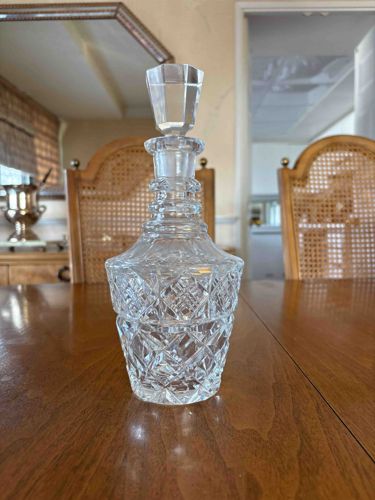
This is a vintage colorless lead crystal decanter, likely of European origin (such as Czech/Bohemian or Irish) dating to approximately the 1950s. The vessel features a tapered, multi-ringed neck transitioning into a wide, angular shoulder and a cylindrical body. The exterior is ground and polished with a classic deep criss-cross diamond cutting pattern, interspersed with vertical notches that provide exceptional light refraction and brilliance. It is topped with a heavy, multi-faceted geometric stopper that appears original to the piece, featuring a ground-glass plug for an airtight seal. Physically, the crystal exhibits high clarity and a substantial weight, characteristic of high-lead content glassware from the mid-20th century. The craftsmanship is evidenced by the precision of the diamond points and the sharp, clean edges of the facets. Regarding condition, the piece presents well with no visible clouding or 'sick glass' syndrome; however, typical wear such as minor shelf friction on the base and possible micro-chipping to the sharp cut edges should be expected given its age. No prominent maker's marks are visible in the image, which is common for etched or paper-labeled crystal of this era. This style embodies the post-war elegance of traditional barware.
AI Appraisal Report

·AI can make mistakes·Verify before acting
I have carefully examined the provided images and descriptions of this Mid-Century lead crystal spirits decanter. The piece exhibits the high refractive index and precision hand-cutting consistent with mid-20th-century European production, specifically from regions like Bohemia or firms such as Waterford. The classic diamond-and-fan motif remains a staple of traditional barware, and the heavy geometric stopper appears to be original and well-fitted. Upon visual inspection, the clarity of the vessel is excellent, showing no signs of alkali leaching (glass sickness). The authenticity of the piece as a vintage lead crystal item is supported by the crispness of the facet edges and the visible 'fire' in the light refraction. The market for vintage colorless crystal is currently stable but selective. While the craftsmanship is superior to modern machine-made equivalents, the lack of a visible acid-etched signature (such as Baccarat or Waterford) places this in the category of 'fine unsigned' crystal, which slightly limits its ceiling in the secondary market. Current demand is driven by the 'home bar' revival, making functional decanters of this quality highly desirable. Note that this appraisal is based on photographic evidence. A formal valuation would require an in-person inspection to verify weight, check for 'ring' resonance, and use a loupe to identify any micro-chips or internal fractures not visible here. Furthermore, archival provenance or original paper labels would be necessary to attribute the piece to a specific glasshouse. Without a physical signature, this remains a high-quality decorative asset rather than a rare collector’s investment.

Get your items appraised

Instant estimates of your treasures with AI-powered appraisals

Browse More Appraisals