AI Appraisal Estimate

AI-generated estimates · not official valuations

From the user

What was submitted

Photo and notes provided by the user — not generated by AI

Submitted item photo
Submitted photo · June 17, 2026

User's notes

Leather green glass decanter with unknown markings on base on

AI analysis below

AI appraisal

AI analysis & estimate

AI-Generated · Verify before acting

Everything below is generated by AI for informational purposes only. AI can make mistakes — the AI may misidentify items or misattribute them (artist, maker, brand, designer, origin, era). This is not an official valuation and should not be used for insurance, sale, tax, estate, legal, or lending purposes — or any decision requiring a certified appraisal. It is not an authoritative claim about any person, brand, or rights holder — do not share or rely on it as a factual statement about a third party. Always consult qualified professionals before making financial decisions.

Note

This analysis also relies on unverified notes provided by the user, which may be incomplete or inaccurate and could affect the result.

Read the full disclaimer

AI Identification

·Not independently authenticated·Verify before acting

Vintage Florentine Leather-Wrapped Green Glass Wine Decanter

Vintage Glassware & Collectible Barware

AI Estimated Value

·Not an official valuation·Verify before acting

$45 - $75

As of June 17, 2026

AI Item Analysis

·AI can make mistakes·Verify before acting
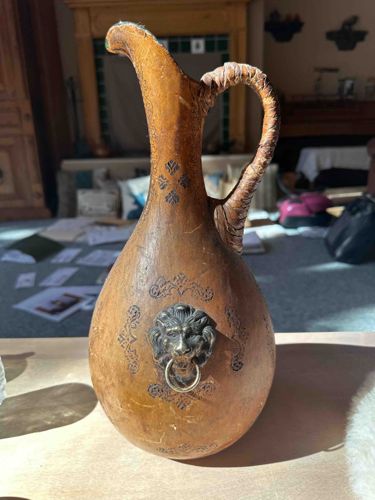
This is a vintage Italian-style wine decanter featuring a distinct pear-shaped body and an elongated, flared neck with a curved pouring lip. The core of the vessel is constructed of green glass, which is entirely encased in a hand-treated, tan-colored leather sheath. The leather is decorated with various Florentine-style gold and dark ink embossed tooling, including floral quatrefoil motifs on the neck and ornate scrollwork borders. A prominent cast metal lion's head with a drop-ring handle is mounted centrally on the body, adding a neoclassical aesthetic. The handle is intricately constructed with braided or cord-wrapped leather, providing a textured grip. Condition-wise, the leather exhibits a heavy vintage patina with visible surface abrasions, minor scuffing around the spout, and darkening consistent with age and handling. There is notable wear along the seams and edges, particularly where the leather meets the base and the handle joints. This style of barware was common in mid-20th century Italy (circa 1950s-1970s), often produced in the Empoli region. The craftsmanship reflects a decorative souvenir quality, blending glassblowing with traditional leatherworking techniques.

AI Appraisal Report

·AI can make mistakes·Verify before acting
Based on my examination of the provided descriptions and images, I have assessed this mid-century Florentine leather-wrapped green glass decanter. This item is a classic example of Italian decorative barware, likely produced in the Empoli region between the late 1950s and 1970s. The neoclassical lion’s head motif and gold-embossed tooling are hallmark features of the 'Florentine' style popular with tourists and exporters during this era. The item shows significant signs of age, which I consider to be 'heavy vintage patina.' The abrasions and scuffing on the leather, particularly around the handle and spout, are consistent with decades of use but do impact the final valuation. The green glass interior appears intact; however, the wear on the leather seams suggests the adhesive may be aging. While this wear offers character, collectors typically favor pieces with more vibrant, intact gilding. Market demand for mid-century Italian barware remains steady among vintage enthusiasts, though these decanters were mass-produced for the giftware market, which limits their rarity. Similar examples frequently appear in online auctions and estate sales within the $40 to $85 range depending on the intricacy of the metalwork. Limitations: My assessment is based on visual data. A physical inspection is required to check for hidden cracks in the glass under the leather or to confirm the material of the metal casting (likely a non-precious zinc alloy). Verification of the 'unknown markings' on the base would require a high-resolution macro-photograph or a charcoal rubbing of the mark to determine if it belongs to a specific manufacturer like Cellini or a similar workshop. Full authentication of the age would also involve testing the leather’s tannins and chemical composition of the glass.

Get your items appraised

Instant estimates of your treasures with AI-powered appraisals

Browse More Appraisals