AI estimate as of October 24, 2025 · verify with a professional before acting
AI-Generated · Verify before acting
Everything on this page is generated by AI for informational purposes only. AI can make mistakes — the AI may misidentify items or misattribute them (artist, maker, brand, designer, origin, era). This is not an official valuation and should not be used for insurance, sale, tax, estate, legal, or lending purposes — or any decision requiring a certified appraisal. It is not an authoritative claim about any person, brand, or rights holder — do not share or rely on it as a factual statement about a third party. Always consult qualified professionals before making financial decisions.
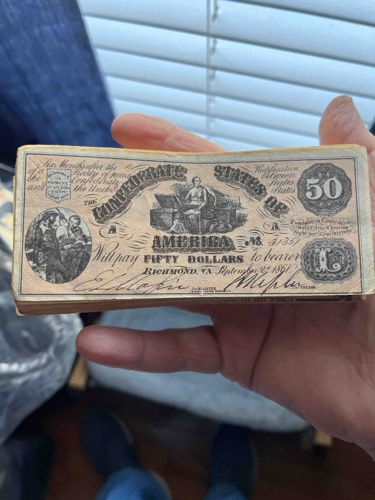
This item is a Confederate States of America paper currency, specifically a Fifty Dollar bill, dated September 23, 1861, from Richmond, VA. The bill is rectangular in shape, approximately 7 inches by 3 inches, and printed on a light-colored paper that appears to have yellowed with age, suggesting a cotton-linen blend common for currency of that era. The primary color scheme is black ink on a light background, with some subtle reddish-brown or sepia tones that could indicate a security feature or aging. The obverse features an elaborate design including the text 'THE CONFEDERATE STATES OF AMERICA' prominently across the top. To the left, there's a vignette depicting two figures, possibly soldiers or allegorical representations, in a detailed scene. The center features a seated female figure, possibly Liberty or Columbia, framed by what appears to be agricultural implements or industry symbols. To the far right, a large numeral '50' is enclosed in an ornate oval. Below the central design, the phrase 'Will pay FIFTY DOLLARS to bearer' is printed, along with the date 'RICHMOND, VA. September 23, 1861.'. The serial number 'M 51337' is visible. There are script signatures, likely of treasury officials, at the bottom. The condition of the visible bill, which appears to be the top note of a stack, shows significant wear, creasing, and discoloration consistent with its age and historical context. There are no obvious tears or major repairs, but the overall crispness of the printing has diminished, and the paper shows general softening and handling marks. The edges appear somewhat frayed. The printing quality, while intricate for its time, reflects the wartime production constraints, with some slight misalignment and ink variations. This particular style of note with the central seated figure and dated 1861 is characteristic of early Confederate currency issuances.
AI Appraisal Report
Based on my visual examination of the provided image, this Confederate States of America Fifty Dollar bill, dated September 23, 1861, Richmond, VA, exhibits characteristics consistent with authentic early CSA currency. The design elements, including the central seated figure, the vignette on the left, the prominent 'FIFTY DOLLARS' text, and the serial number format 'M 51337', align with known specimens of this issue. The printing quality, with some subtle misalignment and ink variations, is typical of wartime production.
In terms of condition, I assess this note to be in 'Good' to 'Very Good' condition (G-VG) according to numismatic grading standards. It shows significant wear, creasing, and discoloration consistent with its age and use. The edges appear somewhat frayed, and the paper has softened. While there are no obvious tears or major repairs visible, the overall crispness has diminished. This level of wear affects its market value, as collectors generally prefer higher-grade examples.
Market conditions for Confederate currency are fairly stable, with consistent demand from Civil War and numismatic collectors. This particular issue, while historical, is not exceedingly rare, especially in lower grades. Comparables in similar condition typically fetch between $100 and $200. Higher-grade examples could command significantly more. Factors impacting value here are primarily the condition and the general availability of this specific type.
A crucial limitation of this appraisal is the reliance solely on an image. Full authentication would require an in-person examination to assess paper quality, watermarks (if any), microscopic print details, and the possibility of advanced counterfeiting techniques. Provenance documentation, though rarely available for such items, would also enhance verification.