AI Appraisal Estimate

AI-generated estimates · not official valuations

From the user

What was submitted

Photo and notes provided by the user — not generated by AI

Submitted item photo
Submitted photo · June 2, 2026

User's notes

No additional notes provided.

AI analysis below

AI appraisal

AI analysis & estimate

AI-Generated · Verify before acting

Everything below is generated by AI for informational purposes only. AI can make mistakes — the AI may misidentify items or misattribute them (artist, maker, brand, designer, origin, era). This is not an official valuation and should not be used for insurance, sale, tax, estate, legal, or lending purposes — or any decision requiring a certified appraisal. It is not an authoritative claim about any person, brand, or rights holder — do not share or rely on it as a factual statement about a third party. Always consult qualified professionals before making financial decisions.

Read the full disclaimer

AI Identification

·Not independently authenticated·Verify before acting

Series 1963 Ten Dollar Federal Reserve Note

Paper Currency / Numismatics

AI Estimated Value

·Not an official valuation·Verify before acting

$12.00 - $15.00

As of June 2, 2026

AI Item Analysis

·AI can make mistakes·Verify before acting
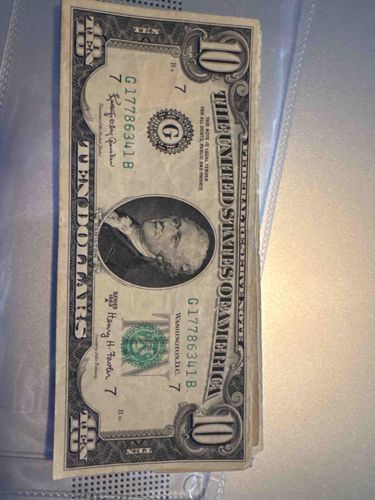
This is a United States Ten Dollar Federal Reserve Note from the Series of 1963. The bill features a portrait of Alexander Hamilton, the first Secretary of the Treasury, centered in an oval frame. To the left of the portrait sits the Federal Reserve District Seal for Chicago, Illinois (identified by the letter 'G' and number '7'). To the right is the green Treasury Department seal. The note bears the serial number G17786341B and features the signatures of Kathryn O'Hay Granahan (Treasurer of the United States) and Henry H. Fowler (Secretary of the Treasury). The paper substrate exhibits significant signs of age and circulation; notable condition issues include a pronounced vertical center crease, several minor horizontal folds, and general wrinkling across the surface. The edges show slight fraying and corner rounding, typical for currency of this age that has been handled. The printing remains legible with a distinct green ink used for the Treasury seal and serial numbers, and dark black ink for the primary engraving. The paper shows a slight yellowing or patina indicative of its 60-plus-year age. This particular series is historically significant as it was the first series of $10 bills to omit the clause 'will pay to the bearer on demand,' reflecting a change in monetary policy.
AI Appraisal Report

·AI can make mistakes·Verify before acting
I have conducted a visual examination of this Series 1963 $10 Federal Reserve Note (Chicago District). The note exhibits characteristics consistent with genuine legal tender of this era, including the fine line engraving of Alexander Hamilton and the specific typography of the Granahan-Fowler signature combination. However, its condition is graded as 'Very Good' to 'Fine' at best. The pronounced vertical center crease, multiple horizontal folds, and general paper softening indicate heavy circulation. These defects significantly limit its numismatic premium. This series is historically notable for being the first to remove the 'will pay to the bearer on demand' clause, marking the transition to purely fiat currency. While this adds historical interest, the 1963 series was produced in massive quantities (over 508 million for the Chicago district alone), and circulated examples remain common in the secondary market. Current market comparables for a note in this worn state typically range from face value to a small premium for collectors of specific blocks or series sets. Higher values are reserved for 'Uncirculated' (Crisp Uncirculated) specimens or those with 'Star' serial numbers. I must state that this appraisal is based on digital imagery. A physical examination is required to definitively verify the intaglio feel of the ink, the presence of red and blue security fibers within the paper, and to ensure no chemical cleaning or restoration has occurred. Full authentication would involve backlighting to check for internal paper integrity and precise measurement of the margins.

Get your items appraised

Instant estimates of your treasures with AI-powered appraisals

Browse More Appraisals