These notes were written by the person who submitted this item. Appraiser.AI has not verified them, and the AI's identification and estimate may rely on them.
AI Estimated Value
Not an official valuation
$250-400
AI estimate as of December 2, 2025 · verify with a professional before acting
AI-Generated · Verify before acting
Everything on this page is generated by AI for informational purposes only. AI can make mistakes — the AI may misidentify items or misattribute them (artist, maker, brand, designer, origin, era). This is not an official valuation and should not be used for insurance, sale, tax, estate, legal, or lending purposes — or any decision requiring a certified appraisal. It is not an authoritative claim about any person, brand, or rights holder — do not share or rely on it as a factual statement about a third party. Always consult qualified professionals before making financial decisions.
This analysis also relies on unverified notes provided by the user, which may be incomplete or inaccurate and could affect the result.
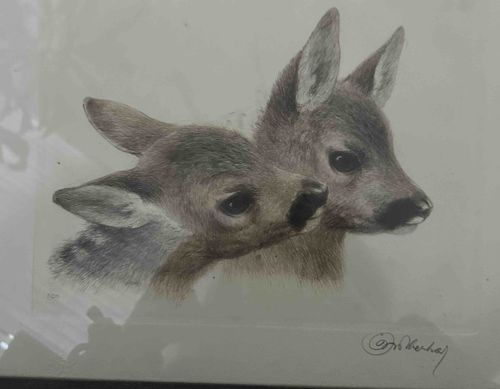
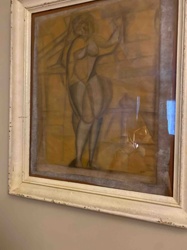
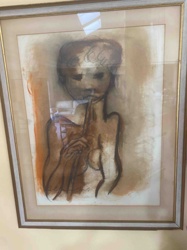
This item is a drawing, likely executed with colored pencils or pastels, depicting two fawn heads. The composition features one fawn's head slightly behind and to the right of the other, with both looking towards the right side of the frame. The fawns are rendered with soft, naturalistic tones of brown, grey, and hints of white, capturing the delicate texture of their fur. Their eyes are dark and expressive, suggesting a youthful innocence. The background appears to be a plain, light-colored surface, possibly off-white paper or board, against which the fawns stand out. Slight reflections are visible on the surface, indicating the drawing might be housed under glass or a protective layer, suggesting it is framed or soon to be. A signature, which appears to read 'M. Berhaj' or a similar script, is discernable in the lower right corner, executed in a dark, possibly black, medium. The style is realistic, focusing on capturing the tender characteristics of young deer. No significant damage like tears or major discoloration is immediately apparent from the provided image, but some surface reflections make a thorough condition assessment challenging. The craftsmanship appears to be of good quality, demonstrating skilled rendering of animal portraiture. The period style is classic realism, making it difficult to pinpoint an exact age without further information, but it likely dates from the mid to late 20th century or early 21st century.
AI Appraisal Report
I have examined the image of the 'Two Fawn Heads Drawing.' Visually, the drawing appears to be in good condition. The execution displays a skilled hand, capturing the delicate features and fur texture of the fawns with a naturalistic approach, likely using colored pencils or pastels. The colors are soft and harmonious. I note the signature 'M. Berhaj' in the lower right, which is a key identifying marker. The reflections visible indicate it is housed under protection, which generally helps preserve delicate media. However, these reflections also limit my ability to fully assess the paper's condition, identify any subtle discoloration, or confirm the exact medium without direct physical inspection.
In terms of market conditions, realistic animal portraiture, particularly of endearing subjects like fawns, typically holds a steady but not exceptionally high demand, unless by a highly sought-after artist. The style suggests a mid-20th to early 21st-century origin. Without further information on the artist 'M. Berhaj,' such as their exhibition history, accolades, or established market presence, this piece is appraised primarily on its aesthetic merit and craftsmanship as a decorative work of art, rather than as a blue-chip investment piece. Comparables would include similar realistic wildlife drawings by lesser-known artists, often found in regional galleries or online art marketplaces.
Authenticity verification from an image alone is limited. While the signature is visible, I cannot definitively confirm its authenticity or if it matches other known works by this artist. For full authentication, I would require an in-person examination to inspect the paper, medium application, and closely scrutinize the signature for consistency with any documented examples of 'M. Berhaj's work. Provenance documentation, such as purchase receipts or exhibition history, would also significantly aid in confirming authenticity and potentially increasing value. Given the limitations, the value range reflects its quality as an original work without the added premium of a highly established artist or fully verified provenance.