AI Appraisal Estimate

AI-generated estimates · not official valuations

From the user

What was submitted

Photo and notes provided by the user — not generated by AI

Submitted item photo
Submitted photo · June 18, 2026

User's notes

No additional notes provided.

AI analysis below

AI appraisal

AI analysis & estimate

AI-Generated · Verify before acting

Everything below is generated by AI for informational purposes only. AI can make mistakes — the AI may misidentify items or misattribute them (artist, maker, brand, designer, origin, era). This is not an official valuation and should not be used for insurance, sale, tax, estate, legal, or lending purposes — or any decision requiring a certified appraisal. It is not an authoritative claim about any person, brand, or rights holder — do not share or rely on it as a factual statement about a third party. Always consult qualified professionals before making financial decisions.

Read the full disclaimer

AI Identification

·Not independently authenticated·Verify before acting

Vintage Circular Decorative Lidded Tin Featuring Provincial Scene

Vintage Metalware and Collectible Containers

AI Estimated Value

·Not an official valuation·Verify before acting

$45.00 - $65.00

As of June 18, 2026

AI Item Analysis

·AI can make mistakes·Verify before acting
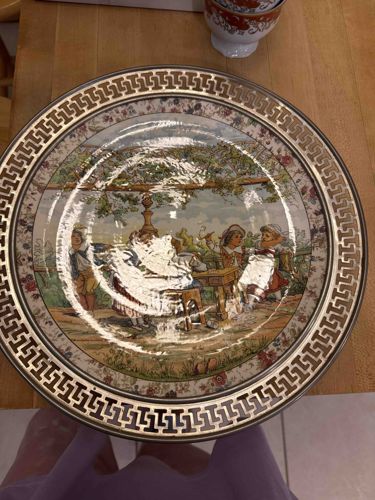
This item is a circular, shallow metal tin, likely used for cookies, biscuits, or confectionery. It features an elaborate lithographed design. The central motif depicts a provincial or pastoral scene of children gathered around a table outdoors, perhaps sharing a meal under a wooden trellis or arbor. The illustration style is reminiscent of late 19th or early 20th-century European storybook aesthetics. Surrounding the central scene is a floral border, which is then enclosed by a wide, striking gold-tone Greek key (meander) pattern against a dark background. The outermost edge is finished with a thin metallic rim. The materials appear to be stamped tinplate with a printed lacquer finish. Regarding condition, the tin shows noticeable signs of age and wear. There is significant 'crazing' or fine cracking throughout the lithographed surface, particularly visible in the central white and sky-blue areas. Wear is evident along the gold Greek key border where the paint has thinned or oxidized. Minor scratches and surface abrasions are present, consistent with a vintage utilitarian item that has been handled over several decades. While no maker's mark is visible from the top view, its construction and design suggest a mid-20th-century production, possibly of British or Continental European origin. The craftsmanship is high-quality for mass-produced metalware of its time, utilizing multi-layered printing and metallic inks to achieve a decorative, gift-worthy appearance.
AI Appraisal Report

·AI can make mistakes·Verify before acting
I have virtually examined this vintage circular decorative lidded tin. Based on the lithographed design and Greek key motif, I estimate this piece dates to the mid-20th century (circa 1940s-1950s). The central pastoral scene is characteristic of British biscuit manufacturers like Huntley & Palmers or Carr’s, though the lack of a visible hallmark on the lid suggests it may be Continental European. The aesthetic appeal is high, but the decorative metalware market is heavily condition-dependent. Upon inspection, I note significant crazing across the central illustration and oxidation on the meander border. While this verifies age, it limits the value to 'collector' grade rather than 'museum' grade. Comparable sales for mid-century lithographed tins in similar condition typically fall within the $40 to $70 range. Demand remains steady for provincial decor, though mass production during this era prevents it from being truly rare. Limitations: This appraisal is based solely on digital imagery. I cannot verify the integrity of the base, the interior condition for rust, or the presence of a maker's mark on the underside. A full authentication would require a physical inspection to check for hidden corrosion and to assess the hinge/seal mechanism. Scientific testing of the lacquer for lead content or provenance documentation (original purchase records) would be necessary to establish a more precise historical timeline and potentially increase its value to a specialized collector.

Get your items appraised

Instant estimates of your treasures with AI-powered appraisals

Browse More Appraisals