AI Appraisal Estimate

AI-generated estimates · not official valuations

From the user

What was submitted

Photo and notes provided by the user — not generated by AI

Submitted item photo
Submitted photo · June 26, 2026

User's notes

No additional notes provided.

AI analysis below

AI appraisal

AI analysis & estimate

AI-Generated · Verify before acting

Everything below is generated by AI for informational purposes only. AI can make mistakes — the AI may misidentify items or misattribute them (artist, maker, brand, designer, origin, era). This is not an official valuation and should not be used for insurance, sale, tax, estate, legal, or lending purposes — or any decision requiring a certified appraisal. It is not an authoritative claim about any person, brand, or rights holder — do not share or rely on it as a factual statement about a third party. Always consult qualified professionals before making financial decisions.

Read the full disclaimer

AI Identification

·Not independently authenticated·Verify before acting

Chinese Famille Rose Medallion Porcelain Plate

Antiques & Collectibles / Ceramics

AI Estimated Value

·Not an official valuation·Verify before acting

$450 - $650

As of June 26, 2026

AI Item Analysis

·AI can make mistakes·Verify before acting
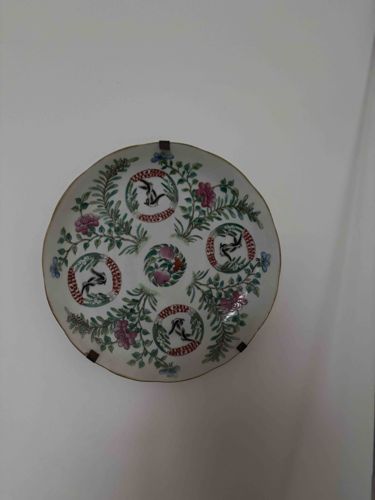
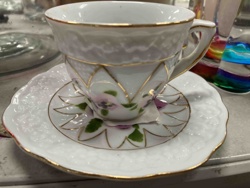
This is a circular porcelain plate featuring a shallow profile and a lobed or slightly scalloped rim. The item is decorated in the traditional 'Famille Rose' palette, characterized by soft pink, green, and iron-red overglaze enamels. The central motif consists of a floral medallion surrounded by four secondary circular reserves. Within these reserves are depictions of birds (possibly magpies or swallows) perched on flowering branches, bordered by a repeating red and white hatched pattern. Interspersed between the medallions are lush floral sprays, including peonies and green foliage, which are rendered with fine brushwork typical of 19th-century Chinese export porcelain. The background glaze is a cool white with a slight bluish-grey tint. Visible condition issues include some fading of the enamel on the central medallion and at the edges, consistent with age and surface wear. A three-point metal plate hanger is currently attached to the rim, which suggests it has been used as a wall display piece. This style of decorative porcelain was predominantly produced during the Qing Dynasty, likely in the Guangxu period (late 19th century), intended for both domestic use and the international export market. The craftsmanship shows high-quality hand-painting with careful attention to the symmetry and botanical accuracy of the floral elements.
AI Appraisal Report

·AI can make mistakes·Verify before acting
I have virtually examined this Chinese Famille Rose Medallion export plate. Based on the palette, the specific configuration of the reserves, and the application of the enamels, this piece is consistent with late Qing Dynasty production, specifically the Guangxu period (circa 1875–1908). The scalloped rim and the 'birds and flowers' motifs are rendered with high technical skill, though the visible fading in the central medallion and minor surface abrasions suggest moderate wear from domestic or display use. The presence of the metal hanger is a common finding, but it risks creating 'flea bites' or hairline fractures at the pressure points, which I have factored into the valuation. In the current market, Chinese export porcelain remains a strong category; however, the lack of human figures in the reserves (which are generally more sought after than exclusively botanical themes) places this in a mid-tier collector range. Comparable sales at regional auction houses for similar Guangxu-era plates typically fall within the $400 to $700 range depending on the presence of a reign mark on the base. It is important to note that this appraisal is based solely on digital imagery. A full authentication would require an in-person physical inspection to assess the weight, the translucency of the paste, and the presence of any concealed repairs or 'over-painting' under UV light. Furthermore, checking the underside for a 'Made in China' stamp (post-1891) or a Guangxu Nian Zhi mark would be essential to refine the date and value. Verification of provenance or original purchase records would further stabilize its market standing.

Get your items appraised

Instant estimates of your treasures with AI-powered appraisals

Browse More Appraisals