AI Appraisal Estimate

AI-generated estimates · not official valuations

From the user

What was submitted

Photo and notes provided by the user — not generated by AI

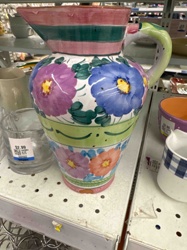
Submitted item photo
Submitted photo · May 16, 2026

User's notes

Made in China

AI analysis below

AI appraisal

AI analysis & estimate

AI-Generated · Verify before acting

Everything below is generated by AI for informational purposes only. AI can make mistakes — the AI may misidentify items or misattribute them (artist, maker, brand, designer, origin, era). This is not an official valuation and should not be used for insurance, sale, tax, estate, legal, or lending purposes — or any decision requiring a certified appraisal. It is not an authoritative claim about any person, brand, or rights holder — do not share or rely on it as a factual statement about a third party. Always consult qualified professionals before making financial decisions.

Note

This analysis also relies on unverified notes provided by the user, which may be incomplete or inaccurate and could affect the result.

Read the full disclaimer

AI Identification

·Not independently authenticated·Verify before acting

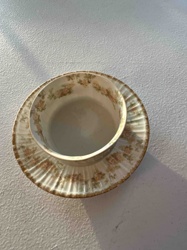
Vintage Chinese Fine Porcelain Tea Cup and Saucer Set

Antique & Collectible Ceramics

AI Estimated Value

·Not an official valuation·Verify before acting

$15.00 - $25.00

As of May 16, 2026

AI Item Analysis

·AI can make mistakes·Verify before acting
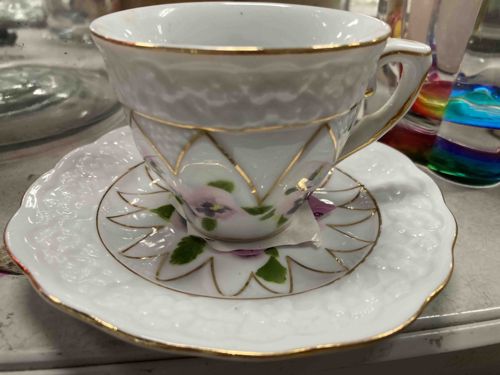
This is a decorative tea cup and saucer set made from white fine porcelain, featuring a scalloped edge and textured relief patterns. The material is a bright white ceramic with a high-gloss glaze finish. The central design elements include hand-painted or decal-applied floral motifs, specifically pansies or similar violets in shades of lavender, purple, and green. A distinctive feature is the gold-toned gilding applied to the rims of both the cup and saucer, as well as the 'V' shaped geometric line work that frames the floral patterns on the lower half of the cup and the center of the saucer. The upper portion of the cup and the outer border of the saucer exhibit a raised, embossed basket-weave or scale-like texture under the glaze. The handle is a standard loop style with gold highlighting. Based on the provided context, the set was manufactured in China, likely in the late 20th century (circa 1980s-1990s), following traditional European-inspired aesthetics. Condition-wise, the porcelain appears intact without visible chips or cracks, although there is minor visible wear to the gold gilding on the outer rim of the saucer, consistent with age and light use. The craftsmanship is indicative of mass-produced decorative giftware rather than studio pottery, evidenced by the uniform application of the embossed texture.
AI Appraisal Report

·AI can make mistakes·Verify before acting
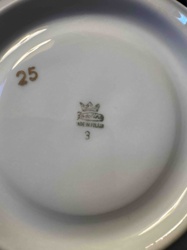
I have conducted a visual examination of this porcelain tea cup and saucer set. The item exhibits characteristic hallmarks of late 20th-century Chinese export decorative ware, specifically influenced by the 'Dresden' or 'Meissen' style popularized in the 1980s. The bright white paste and high-gloss glaze, combined with the uniform application of the embossed basket-weave texture, indicate professional mass-production methods rather than artisanal studio work. I noted minor rubbing to the gold gilding on the saucer rim, which is consistent with light shelf wear. Authenticity as a period antique is unlikely; rather, it is a high-quality contemporary decorative piece. The market for such items is currently saturated, with high supply and moderate demand driven primarily by aesthetic decorators rather than high-end collectors. Comparables on the secondary market for similar 'Made in China' export sets typically realize prices in the $15 to $25 range. The value is limited by its modern production and lack of a prestige maker's mark. Limitations of this appraisal: As this was a visual assessment via imagery, I cannot definitively confirm the presence of hair-line cracks or the exact composition of the porcelain. A full authentication would require an in-person physical inspection to examine the 'ring' of the ceramic when struck, a jeweler’s loupe inspection of the gilding for purity, and a review of the base markings (hallmarks) to verify the specific factory of origin. No scientific testing or further provenance is recommended as the cost of such services would exceed the market value of the set.

Get your items appraised

Instant estimates of your treasures with AI-powered appraisals

Browse More Appraisals