These notes were written by the person who submitted this item. Appraiser.AI has not verified them, and the AI's identification and estimate may rely on them.
AI Estimated Value
Not an official valuation
$120-180
AI estimate as of September 13, 2025 · verify with a professional before acting
AI-Generated · Verify before acting
Everything on this page is generated by AI for informational purposes only. AI can make mistakes — the AI may misidentify items or misattribute them (artist, maker, brand, designer, origin, era). This is not an official valuation and should not be used for insurance, sale, tax, estate, legal, or lending purposes — or any decision requiring a certified appraisal. It is not an authoritative claim about any person, brand, or rights holder — do not share or rely on it as a factual statement about a third party. Always consult qualified professionals before making financial decisions.
This analysis also relies on unverified notes provided by the user, which may be incomplete or inaccurate and could affect the result.
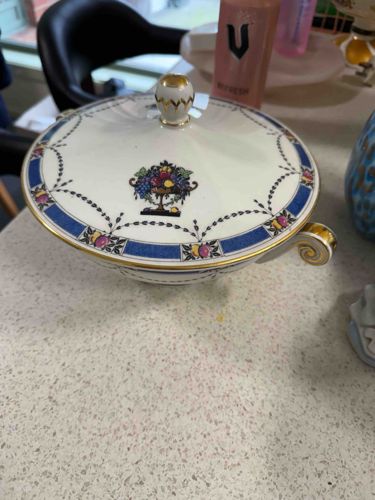
This is a Royal Worcester covered casserole dish, likely part of their 'Ashby' pattern, as indicated by the provided context. The item is made of fine porcelain, characterized by a creamy white base with vibrant polychrome decoration and significant gold gilding. The lid, which is predominantly visible, features a central motif of a fruit basket or urn overflowing with colorful fruits (grapes, berries, apples) and foliage in shades of purple, green, yellow, and red. Radiating from this central motif are elegant, stylized dark blue dotted lines forming arches, interspersed with smaller floral or berry clusters in pinks, yellows, and greens. A prominent border encircles the edge of the lid, consisting of a rich cobalt blue band decorated with repeating gold geometric patterns or stylized leaves, bordered by fine gold lines. The finial, or handle, on the lid is a small, inverted teardrop shape, gilded in gold with a chevron or zig-zag pattern around its base, showcasing meticulous detail. A small, scrolled handle is partially visible on the side of the lower dish, also adorned with gold. The overall aesthetic is one of refined elegance and traditional design, characteristic of early to mid-20th-century English porcelain. No significant visible damage such as chips, cracks, or extensive wear to the gilding is apparent from the image, suggesting good to excellent condition. The craftsmanship appears high quality, with precise hand-painted or transferware decoration and consistent application of gilding.
AI Appraisal Report
Based on my visual examination of the Royal Worcester 'Ashby' Covered Casserole Dish, I find it to be in excellent condition. The polychrome decoration featuring the fruit basket motif and surrounding floral clusters is vibrant, with no visible fading. The extensive gold gilding on the finial, border, and handle appears remarkably intact, showing no significant wear or loss, which is crucial for antique porcelain value. The creamy white porcelain body also seems free from chips, cracks, crazing, or repairs. The design, as described, is consistent with Royal Worcester's 'Ashby' pattern, known for its elegant, traditional aesthetic prevalent in early to mid-20th-century English porcelain. Authenticity is strongly supported by the detailed craftsmanship and the 'Royal Worcester Crown England Ashby' marking provided by the owner.
Market conditions for Royal Worcester, while respectable, are not as robust as some other luxury porcelain brands. While 'Ashby' is an attractive pattern, it's not among their rarest or most highly coveted series. Comparables for Royal Worcester covered casseroles or tureens in similar condition and patterns typically fetch in the range of $100-$200. Demand is moderate, primarily from collectors of English porcelain or those seeking traditional serveware. The rarity of a single casserole dish is low; however, the excellent condition significantly enhances its appeal.
Factors impacting value positively include its superb condition and the enduring appeal of its classic design. Without physical inspection, I cannot confirm the absence of hairline cracks, invisible repairs, or manufacturing flaws that might affect value. A hands-on examination would allow me to thoroughly check for surface imperfections, wear to the firing, and subtle damage not discernible in images. Verifying the exact production period through backstamps (though the 'Ashby' mention helps) and confirming the integrity of the glaze and body would require in-person assessment, as would testing for any previous restoration work.