AI estimate as of October 21, 2025 · verify with a professional before acting
AI-Generated · Verify before acting
Everything on this page is generated by AI for informational purposes only. AI can make mistakes — the AI may misidentify items or misattribute them (artist, maker, brand, designer, origin, era). This is not an official valuation and should not be used for insurance, sale, tax, estate, legal, or lending purposes — or any decision requiring a certified appraisal. It is not an authoritative claim about any person, brand, or rights holder — do not share or rely on it as a factual statement about a third party. Always consult qualified professionals before making financial decisions.
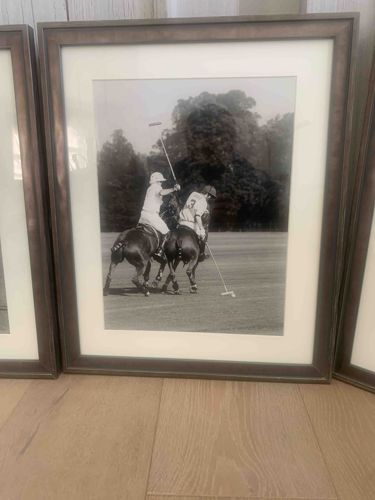
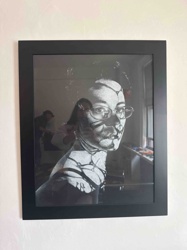
This item is a framed black and white photograph depicting a dynamic scene from a polo match. The photograph captures two polo players on horseback in mid-action, seemingly contending for the ball. One player, wearing a light-colored helmet and uniform, is actively swinging their polo mallet upwards, whilst the other player, wearing a darker helmet and a numbered jersey (partially visible, possibly '3'), leans down with their mallet towards the ground, indicating an attempt to hit the ball. The background features lush, dark foliage from trees, suggesting an outdoor polo field. The photograph itself appears to be a gelatin silver print or a modern reproduction with a similar aesthetic, characterized by a good range of tonal blacks, whites, and grays, contributing to a classic and authentic feel. It is set within a wide, off-white mat board, which provides a clean border and visually separates the image from the frame. The frame is a dark brown, possibly stained wood or a similar material, with a subtle grain visible intermittently. Its profile is relatively simple, with a slight bevel or rounded edge, giving it a somewhat traditional or rustic appearance. The framing includes a protective glass or acrylic covering, though no significant reflections or damage to this surface are immediately visible. The overall condition appears good, with no obvious signs of significant wear, tears, or discoloration on the photograph itself, nor any major damage to the mat or frame. Given the aesthetic, it could be a piece from the mid-20th century or a contemporary print designed to evoke that era. The craftsmanship of the framing seems adequate, providing a sturdy presentation for the artwork.
AI Appraisal Report
I have examined the provided image of this Framed Black and White Polo Match Photograph. Visually, the photograph appears to be in good condition, exhibiting a pleasing tonal range characteristic of a gelatin silver print or a high-quality modern reproduction capturing that aesthetic. There are no obvious signs of significant wear, tears, discoloration, or damage to the print, mat, or dark wooden frame. The wide off-white mat and simple dark frame contribute to a classic presentation.
Authenticity is difficult to ascertain solely from an image. While it visually evokes a mid-20th-century feel, it could equally be a contemporary print designed to mimic that era. Without a visible photographer's signature, edition number, or any accompanying provenance, its origin and age remain speculative. The subject matter of polo matches has a consistent, albeit niche, appeal, often sought by enthusiasts of the sport or vintage photography collectors. However, without knowing the photographer or specific historical significance, it is likely viewed as decorative art.
Market conditions for unsigned, undated, and unprovenanced photographic prints, especially reproductions, are generally modest. Comparable unsigned decorative photographic prints of sporting events typically sell in the $100-$300 range, with prices heavily influenced by the quality of the print, framing, and perceived age. Demand would be moderate, primarily from interior decorators or individuals with an interest in polo. Rarity is low given the subject matter could be a modern reproduction.
Factors significantly impacting its value include the unknown photographer and the lack of dating. To fully authenticate and determine its true value, an in-person examination is crucial. This would allow for inspection of the print's paper type, photographic process (e.g., examining under magnification for halftone dots in case of a modern print), a closer look at the verso for any stamps or annotations, and assessment of the frame's construction. Provenance documentation, such as original receipts or exhibition history, would also be essential for full authentication and to establish any historical significance. Without these, it is valued as an attractive, well-framed decorative print.