AI estimate as of August 21, 2025 · verify with a professional before acting
AI-Generated · Verify before acting
Everything on this page is generated by AI for informational purposes only. AI can make mistakes — the AI may misidentify items or misattribute them (artist, maker, brand, designer, origin, era). This is not an official valuation and should not be used for insurance, sale, tax, estate, legal, or lending purposes — or any decision requiring a certified appraisal. It is not an authoritative claim about any person, brand, or rights holder — do not share or rely on it as a factual statement about a third party. Always consult qualified professionals before making financial decisions.
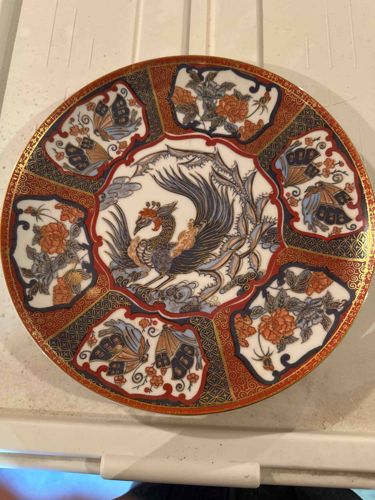
This is a multicolored decorative plate, likely ceramic or porcelain, featuring a central design of a stylized phoenix. The phoenix is depicted with a vibrant red and orange head and a prominent, flowing dark blue/grey tail, possibly with golden accents, perched within an ornate, scrolled border that frames the central motif. The background of the central image appears to be a light off-white or cream color. Surrounding the central phoenix are eight distinct cartouches arranged radially around the plate's rim. Four of these cartouches display detailed floral arrangements in shades of orange, red, and grey, while the alternating four cartouches feature representations of butterflies, also in tones of blue, grey, and brown, against a light background. These cartouches are bordered in red. The sections between these cartouches are filled with a rich, dark red pattern overlaid with intricate gold detailing, possibly a geometric or brocade-like design. The very edge of the plate has a narrow band of gold with a subtle patterning. The plate appears to be in excellent condition with no visible chips, cracks, or significant wear to the glazes or overglaze enamels. The colors are vibrant, suggesting good preservation. Given the detailed artwork and use of a phoenix motif, this plate is likely of East Asian origin, possibly Japanese Imari or Kutani ware, or a similar decorative style. It appears to be an older piece, potentially from the early to mid-20th century, or an earlier reproduction, due to its traditional design and craftsmanship. The quality of the hand-painting and intricate gold work indicates a high level of craftsmanship.
AI Appraisal Report
I have examined the provided image of this Asian-style decorative plate. Based on the visual evidence, the plate appears to be in excellent condition, showing no visible chips, cracks, or significant wear to the glazes or overglaze enamels. The vibrant colors and intricate detailing, particularly the gold work, suggest a high level of craftsmanship. The central phoenix motif, coupled with the radial cartouches featuring butterflies and floral designs against a rich red and gold background, strongly points to an East Asian origin, likely Japanese Imari or Kutani ware, or a similar traditional style.
Authenticity, solely based on images, is challenging. While the design and execution align with historical decorative traditions, a definitive age and origin—and thus authenticity as a specific period piece versus a later reproduction—cannot be confirmed. The quality of hand-painting and gold work is notable, but without in-person examination, I cannot verify the texture of the enamels, the specific type of ceramic body, or the precise nature of the gold application (e.g., whether it's genuine gold leaf or gilded pigment).
Market conditions for decorative plates of this style can be variable. High-quality, authenticated antique pieces, particularly those from renowned kilns or with established provenance, command premium prices. Comparables would include other Japanese Imari or Kutani plates of similar size, age, and decorative complexity that have sold at auction or through reputable dealers. Demand for well-preserved, aesthetically pleasing pieces like this remains steady among collectors of Asian decorative arts. Rarity would depend heavily on the specific period and maker; mass-produced items from the early to mid-20th century are less rare than earlier, artisanal works.
Factors significantly impacting value include confirmed authenticity, age, provenance (history of ownership), and any signatures/marks. Without these, the value remains primarily decorative. To fully authenticate this item and establish its fair market value, an in-person examination is crucial. This would allow for tactile assessment of the ceramic body and glazes, close inspection of brushwork and gold application, and a search for any maker's marks or kiln stamps. Further, scientific testing of materials or pigments could help confirm age, and a provenance report (documentation of its history of ownership) would be invaluable.