AI Appraisal Estimate

AI-generated estimates · not official valuations

From the user

What was submitted

Photo and notes provided by the user — not generated by AI

Submitted item photo
Submitted photo · June 25, 2026

User's notes

No additional notes provided.

AI analysis below

AI appraisal

AI analysis & estimate

AI-Generated · Verify before acting

Everything below is generated by AI for informational purposes only. AI can make mistakes — the AI may misidentify items or misattribute them (artist, maker, brand, designer, origin, era). This is not an official valuation and should not be used for insurance, sale, tax, estate, legal, or lending purposes — or any decision requiring a certified appraisal. It is not an authoritative claim about any person, brand, or rights holder — do not share or rely on it as a factual statement about a third party. Always consult qualified professionals before making financial decisions.

Read the full disclaimer

AI Identification

·Not independently authenticated·Verify before acting

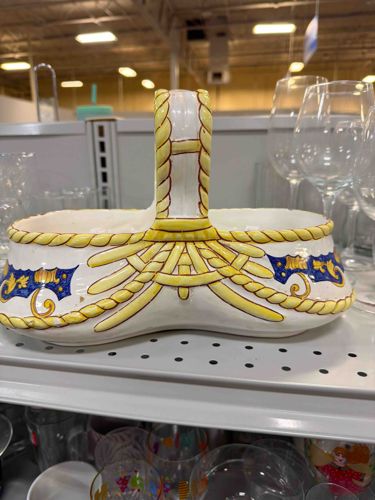
Vintage Majolica Style Ceramic Double-Well Basket Caddy

Decorative Arts / Vintage Ceramics

AI Estimated Value

·Not an official valuation·Verify before acting

$45.00 - $75.00

As of June 25, 2026

AI Item Analysis

·AI can make mistakes·Verify before acting
This item is a decorative ceramic double-well basket or caddy, likely intended for use as a condiment server or a centerpiece planter. It features a distinctive creamy white glazed base with prominent molded relief details. The architecture of the piece includes two oval compartments separated by a central fixed handle that spans the width. The design is heavily defined by yellow-painted molded rope or wicker patterns that border the rims and handle, meeting at a decorative sunburst or fan-like motif in the center. The side panels are adorned with hand-painted underglaze cobalt blue panels featuring golden-yellow scrollwork and foliate scroll designs, reminiscent of Italian Majolica or Deruta-inspired ceramics. Structurally, the vessel is made of earthenware or stoneware, showing a slightly irregular handmade quality in its molding. Regarding condition, there are visible signs of age and wear including fine crazing in the white glaze typical of vintage ceramics and several small nicks or 'flea bites' along the bottom rope-twist edge where the white clay body is exposed through the yellow paint. The craftsmanship suggests a mid-20th-century production, likely European in origin, possibly Italy or Portugal. There are no maker's marks visible on the sides, though one would typically find a signature or stamp on the unglazed foot of the base which is hidden from view.

AI Appraisal Report

·AI can make mistakes·Verify before acting
I have conducted a visual examination of the vintage Majolica-style ceramic double-well basket caddy. The piece displays characteristic features of mid-20th-century decorative earthenware, likely produced in the Mediterranean region (Italy or Portugal) for the export market. The cobalt blue scrollwork against the glazed white ground mimics the 'Raffaellesco' style often found in Deruta pottery, though the execution here appears more mass-produced than high-artisan decorative pieces. Condition-wise, the item shows age-appropriate wear. I observed fine crazing throughout the lead-based glaze and several 'flea bites' or glaze chips along the yellow rope-twist base, exposing the white earthenware body. These flaws are common for soft-paste ceramics of this age but do marginally detract from the value. The yellow overglaze on the handle shows some thinning, suggesting frequent handling. Market demand for mid-century Mediterranean ceramics remains steady for decorators, though values for unsigned functional wares have flattened as younger collectors favor documented manufacturers like Bitossi or Vietri. Comparable items at regional auctions and online marketplaces typically realize between $40 and $80. The lack of a visible maker's mark limits its appeal to high-end collectors. Note: This appraisal is based solely on digital images. Without a physical inspection, I cannot confirm the presence of a 'Made in Italy' stamp or artist signature on the foot, which could increase value by 20%. I also cannot verify if the 'flea bites' have been professionally overpainted. Full authentication would require a tactile check for structural cracks and verification of the base markings to distinguish this from late-20th-century reproductions.

Get your items appraised

Instant estimates of your treasures with AI-powered appraisals

Browse More Appraisals