AI estimate as of October 26, 2025 · verify with a professional before acting
AI-Generated · Verify before acting
Everything on this page is generated by AI for informational purposes only. AI can make mistakes — the AI may misidentify items or misattribute them (artist, maker, brand, designer, origin, era). This is not an official valuation and should not be used for insurance, sale, tax, estate, legal, or lending purposes — or any decision requiring a certified appraisal. It is not an authoritative claim about any person, brand, or rights holder — do not share or rely on it as a factual statement about a third party. Always consult qualified professionals before making financial decisions.
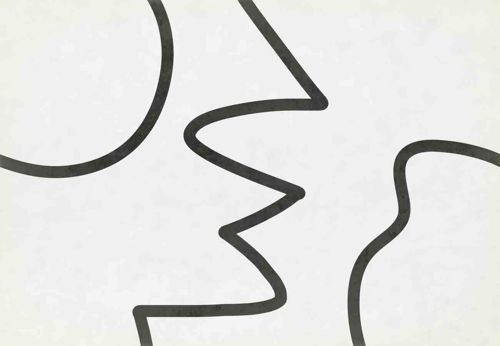
This item is an abstract minimalist line art print, characterized by its stark simplicity and graphic quality. The artwork features thick, dark gray to black lines against a light, off-white background, which appears to have a subtle, textured, possibly canvas-like or paper-like grain. The lines are varied in form, including smooth curves, sharp angles, and zigzag patterns. On the left side, a large, well-defined semicircular or C-shaped curve is visible, suggesting a part of a larger circular element extending beyond the frame. Towards the center, a prominent zigzag pattern dominates, featuring multiple sharp, angular turns. To the right, a more fluid, wavy or serpentine line contrasts with the angularity of the zigzag. The overall composition is abstract, without any discernible representational subject matter, emphasizing form, line, and contrast. There are no visible condition issues such as tears, creases, or major discolorations, and the print appears to be in excellent condition. There are no discernible artist signatures, maker's marks, or stamps visible within the image area. The style points to a modern or contemporary aesthetic, likely dating from the mid-20th century onwards, embracing minimalism and abstract expression. The craftsmanship is indicated by the consistent line weight and smooth execution of the curves and angles, suggesting either a digital print of high quality or a carefully executed hand drawing or printmaking technique.
AI Appraisal Report
I have examined the provided image of this Abstract Minimalist Line Art Print. Visually, the print appears to be in excellent condition, with no visible tears, creases, or significant discoloration. The lines are consistently well-defined, suggesting either a high-quality digital print or a competently executed traditional printmaking technique. The simplicity and graphic quality are characteristic of mid-to-late 20th century to contemporary minimalist and abstract artwork.
Authenticity, based solely on an image, is inherently limited. There are no visible artist signatures, maker's marks, or stamps, which is common for decorative prints but prevents attribution to a specific artist. Without provenance documentation, it is impossible to determine its origin, artist, or specific print run. Market conditions for unsigned, decorative abstract prints like this are generally moderate. Comparable pieces, often produced in editions or as open prints for home decor, typically trade in the $50-$200 range, depending on size, framing, and sales channel. Demand for abstract minimalist art remains consistent, but this specific piece lacks unique identifiers that would elevate its rarity or demand significantly beyond decorative appeal. Factors impacting value negatively include the lack of attribution and the common aesthetic, which makes it difficult to differentiate from countless similar pieces.
For full authentication and to ascertain its true value in the art market, an in-person examination would be critical to determine the printmaking technique (e.g., lithograph, serigraph, giclée), paper quality, and to search for very subtle artist's chop marks or blind stamps not visible in the image. Provenance documentation, such as purchase receipts or exhibition history, would be essential to establish its creator and origin.