AI estimate as of August 6, 2025 · verify with a professional before acting
AI-Generated · Verify before acting
Everything on this page is generated by AI for informational purposes only. AI can make mistakes — the AI may misidentify items or misattribute them (artist, maker, brand, designer, origin, era). This is not an official valuation and should not be used for insurance, sale, tax, estate, legal, or lending purposes — or any decision requiring a certified appraisal. It is not an authoritative claim about any person, brand, or rights holder — do not share or rely on it as a factual statement about a third party. Always consult qualified professionals before making financial decisions.
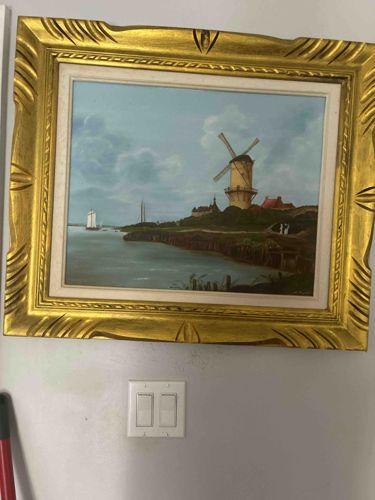
The item is a framed oil painting depicting a classic landscape scene, likely of Dutch or European origin given the prominent windmill. The painting features a large, traditional windmill with rotating sails situated on a raised landmass or cliff overlooking a body of water, possibly a canal, river, or bay. The water shows subtle reflections and has a sailboat with white sails in the distance on the left, and what appears to be other smaller vessels or masts further along the waterline. The landmass is dark and likely represents a rocky or earthen embankment, with hints of green foliage and a few red-roofed buildings visible near the base of the windmill. The sky is predominantly light blue with scattered white and grey clouds, suggesting either an overcast day or a bright, slightly cloudy one. The color palette is muted but distinct, with earthy tones for the land and windmill, cool blues for the water and sky, and accents of white and red. The painting appears to be executed in a realistic to slightly impressionistic style, with visible brushstrokes. The condition of the painting itself seems good, with no obvious major damage, tears, or significant paint loss visible from the image. The entire piece is encased in a large, ornate golden frame. The frame is a prominent feature, likely made of wood with gesso and gold leaf or gold paint, featuring a relief pattern with a series of raised, curvilinear designs, including what looks like stylized foliage or scrollwork and regular indentations along the inner and outer edges. There are also distinct V-shaped carvings at intervals. The gold leaf or paint shows some wear and minor losses, revealing a darker underlayer in places, consistent with age and handling. This wear contributes to a visual patina. The frame includes a visible white liner, providing a boundary between the artwork and the ornate gold. The overall impression is that of a decorative piece, likely from the mid-20th century, consistent with a traditional European landscape style often produced for export or general consumption.
AI Appraisal Report
I have examined the image of this framed oil painting, 'Windmill and Seascape.' Visually, the painting appears to be in good condition with no obvious tears, significant paint loss, or major damage, suggesting it has been reasonably well-preserved. The ornate golden frame, while showing minor wear and some loss to the gold leaf/paint, contributes significantly to the piece's decorative appeal and its overall presentation. This wear is consistent with age and typical handling.
Based on the visual cues, the artwork likely dates from the mid-20th century. It exhibits characteristics of a mass-produced or decorative landscape painting, a genre popular during that period for home decor. While charming and well-executed for its style, there are no immediate visual indicators from the image alone to suggest it is by a highly renowned or listed artist, or that it possesses significant artistic innovation that would command a premium. The general style, subject matter, and apparent execution are common for decorative oil paintings of this era. Given the lack of a discernible artist's signature or distinguishing stylistic features from the image, authenticity specifically regarding authorship cannot be confirmed without further examination.
Market conditions for such decorative landscapes are relatively stable but not exceptionally strong for works without established provenance or artistic merit. Comparables would include similar framed mid-20th century landscape oil paintings found in estate sales, reputable consignment shops, or general online art marketplaces. Demand is generally from individuals seeking decorative pieces to complement interior design. Rarity is not a significant factor here, as many similar pieces were produced.
The primary factors impacting value are its decorative appeal, good condition, and the attractive, well-preserved frame. The lack of an identifiable artist limits its potential value significantly.
Limitations: My assessment of condition and authenticity is based solely on the provided image. A full authentication would necessitate an in-person examination to inspect paint layers, canvas, stretcher, and potential signatures under UV light, as well as a thorough provenance investigation. Without physical inspection, the precise medium, condition nuances, and definitive authorship remain unverified. Scientific testing, such as pigment analysis, would be required for precise dating or to confirm material composition.