AI estimate as of September 24, 2025 · verify with a professional before acting
AI-Generated · Verify before acting
Everything on this page is generated by AI for informational purposes only. AI can make mistakes — the AI may misidentify items or misattribute them (artist, maker, brand, designer, origin, era). This is not an official valuation and should not be used for insurance, sale, tax, estate, legal, or lending purposes — or any decision requiring a certified appraisal. It is not an authoritative claim about any person, brand, or rights holder — do not share or rely on it as a factual statement about a third party. Always consult qualified professionals before making financial decisions.
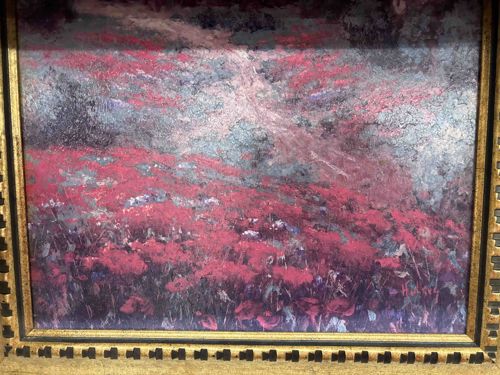
This item is an oil painting depicting an impressionistic landscape, dominated by a vibrant field of red flowers in the foreground and mid-ground. The specific type of red flower appears to be poppies or a similar variety, rendered with short, quick brushstrokes that convey movement and natural form rather than botanical precision. The background consists of a blurred expanse of muted greens, blues, and grays, suggesting distant foliage, sky, or atmospheric effects, typical of Impressionist techniques. The color palette is rich, with strong emphasis on the reds, contrasted by the cooler tones of the background. The texture of the paint application appears thick and impasto in areas, particularly in the floral elements, indicating visible brushwork that adds depth and tactile quality to the surface. The painting is housed within a substantial, ornate gilded frame. The frame features a classic, possibly Rococo or Baroque-inspired, design with repeating carved or molded decorative motifs, likely made of wood and finished with gold leaf or a metallic paint. The visible condition of the painting appears good, with no obvious signs of significant damage, tears, or repairs, though a professional inspection would be required to confirm. The frame exhibits a gentle patina consistent with age, enhancing its antique aesthetic. The overall style suggests a late 19th or early 20th-century Impressionistic or Post-Impressionistic work, characterized by its focus on light, color, and transient moments. The craftsmanship of both the painting and its frame appears to be of good quality, indicating a skilled artist and a well-chosen enclosure that complements the artwork's subject and style.
AI Appraisal Report
Based on my visual examination of the provided image, this Impressionistic Landscape with Red Flowers presents as a charming and well-executed piece. The painting itself appears to be in good condition, showing no immediately discernible tears, major paint losses, or significant repairs. The thick impasto in the floral elements and the looser brushwork in the background are characteristic of the Impressionist style, focusing on light and color. The ornate gilded frame complements the artwork beautifully, appearing structurally sound with a gentle patina consistent with its age, likely late 19th or early 20th century. This combination enhances its overall presentation and appeal.
From a market perspective, anonymous Impressionist or Post-Impressionist landscapes with vibrant floral elements, especially poppies, generally attract steady interest. While not by a recognized master, the quality of execution and the pleasing subject matter make it desirable to collectors of decorative art and those seeking period-appropriate pieces. Comparables for unsigned works of this caliber typically range from the low to mid-thousands, depending on size, condition, and aesthetic appeal. The strong decorative appeal and good condition contribute positively to its demand.
However, it is crucial to state the limitations of an appraisal based solely on images. Authenticity, particularly regarding the specific artist and period, cannot be definitively confirmed without in-person examination. A physical inspection would allow me to assess paint layer integrity, true color representation, and potential signatures or inscriptions obscured in the image. Furthermore, provenance documentation (e.g., bills of sale, exhibition history) would be essential for attributing the work to a specific artist or atelier and could significantly raise its value. Scientific testing, such as pigment analysis or dendrochronology (if on a wood panel), might also be necessary for full authentication and dating.