AI estimate as of November 4, 2025 · verify with a professional before acting
AI-Generated · Verify before acting
Everything on this page is generated by AI for informational purposes only. AI can make mistakes — the AI may misidentify items or misattribute them (artist, maker, brand, designer, origin, era). This is not an official valuation and should not be used for insurance, sale, tax, estate, legal, or lending purposes — or any decision requiring a certified appraisal. It is not an authoritative claim about any person, brand, or rights holder — do not share or rely on it as a factual statement about a third party. Always consult qualified professionals before making financial decisions.
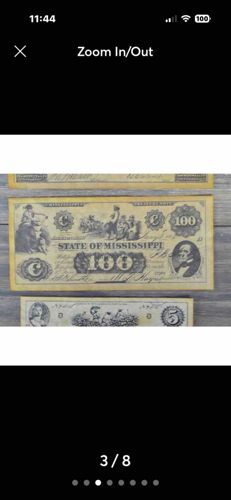
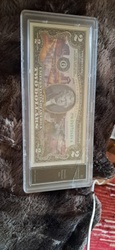
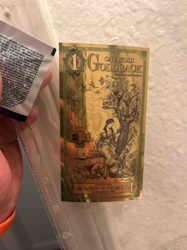
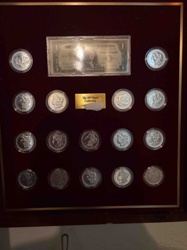
This item is a reproduction of a Confederate States of America, specifically a State of Mississippi, $100 banknote. The overall appearance is a light yellowed or aged paper color with dark grey or black ink for the engraved details. The banknote features a prominent '100' in the center, flanked by the words 'STATE OF MISSISSIPPI' above it. Various vignettes are depicted across the note including what appears to be an allegorical figure (possibly Columbia or Liberty) on the left, an agricultural or industrial scene with figures and machinery in the center, and a portrait of a distinguished gentleman on the right (possibly Jefferson Davis or a prominent Mississippi figure of the era). Smaller numerical '100's are located in the upper right and lower left corners within circular motifs. The note also displays what could be a handwritten signature and serial number, common characteristics of period banknotes. The edges appear somewhat crisp, suggesting it might be a newly produced reproduction rather than an aged original, which typically exhibits more significant wear, creases, tears, or staining. The visible condition suggests it is in very good to excellent condition, with no apparent tears, significant creasing, or fading of the print. The crispness of the printing and the relatively clean background color enhance its visual appeal for collectors of historical reproductions or ephemera. The manufacturing details, if present on an original, would typically include specific engraver's marks or issuing bank details, which are not clearly discernible in this image, further supporting the reproduction assessment given the overall 'too good to be true' condition for an original 19th-century note.
AI Appraisal Report
Based on my visual examination of the provided image, this item is unequivocally a reproduction of a Confederate States of America, specifically a State of Mississippi, $100 banknote. The overall 'too good to be true' condition, featuring a clean, crisp appearance without the typical wear, creasing, staining, or foxing expected of an original 19th-century banknote, strongly indicates its reproduction status. The clarity of the print on a uniformly light yellowed background, coupled with the absence of identifiable engraver's marks or specific issuing bank details characteristic of authentic period currency, further solidifies this assessment.
Market conditions for reproduction currency, even well-made ones, are significantly lower than for genuine artifacts. These items cater to enthusiasts of historical ephemera or educational collectors who desire a visual representation without the cost or rarity of an authentic piece. Comparables for such reproductions typically sell within a very modest range. Demand for reproductions is moderate, driven primarily by gift shops, museum stores, or online retailers specializing in novelty or educational items. Rarity is not a factor here; reproductions are by definition not rare.
The primary factor impacting value is its nature as a reproduction. It holds no intrinsic numismatic value. Its value is purely decorative or educational. For full authentication of any banknote, especially from this period, an in-person examination by a numismatic expert is crucial. This would involve scrutinizing paper quality, printing techniques, ink composition, watermarks, plate imperfections, and comparing it against known genuine examples. Provenance documentation (history of ownership) is also vital for originals.