AI estimate as of October 18, 2025 · verify with a professional before acting
AI-Generated · Verify before acting
Everything on this page is generated by AI for informational purposes only. AI can make mistakes — the AI may misidentify items or misattribute them (artist, maker, brand, designer, origin, era). This is not an official valuation and should not be used for insurance, sale, tax, estate, legal, or lending purposes — or any decision requiring a certified appraisal. It is not an authoritative claim about any person, brand, or rights holder — do not share or rely on it as a factual statement about a third party. Always consult qualified professionals before making financial decisions.
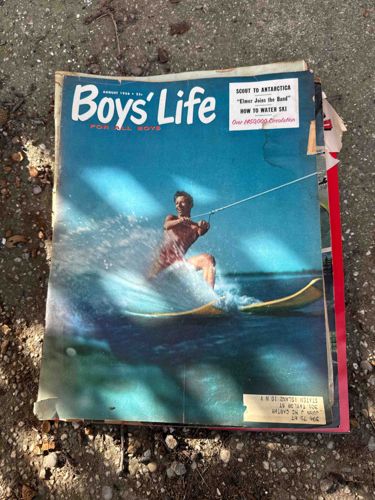
This item is a copy of Boys' Life magazine, specifically the August 1956 issue, as indicated by the date 'August 1956' printed on the top left of the cover. The magazine features a vibrant cover image depicting a young boy actively water skiing, creating a large, white spray behind him. The water is a bright blue-green, suggesting a clear summer day. The 'Boys' Life' logo is prominently displayed in white, stylized font across the top. Below it, the tagline 'FOR ALL BOYS' is present. In the upper right corner, a white rectangular box contains featured articles: 'SCOUT TO ANTARCTICA', 'Elmer Joins the Band', and 'HOW TO WATER SKI', along with 'Our 1,650,000 Circulation'. The bottom right corner of the cover has an address label, now partially torn or creased, that appears to read 'JOHN N. CARTER' and 'STATEN ISLAND 10 N Y'. The overall condition shows significant wear, consistent with its age and likely storage. The corners are creased and dog-eared, particularly the bottom left. The spine appears to be intact but there are visible signs of tearing and fraying along the edges, especially on the right side where some red binding or a red-colored page is exposed. The cover itself has some minor scuffs and marks, and there are folds visible across the top and bottom sections. The magazine is likely constructed from typical magazine paper for its era, with a glossy or semi-glossy cover. This piece falls into the mid-20th-century publication style, reflecting the popular activities and interests of mid-century American youth.
AI Appraisal Report
Upon visual examination of this Boys' Life Magazine, August 1956, I assess its authenticity based on the visible date, prominent logo, and typical mid-century design cues. The cover artwork featuring a boy waterskiing, along with the advertised articles, aligns with publications from that era. The presence of a partial address label for 'JOHN N. CARTER' of 'STATEN ISLAND 10 N Y' further reinforces its historical context as a circulated magazine.
However, its condition significantly impacts its value. I note considerable wear: creased and dog-eared corners, particularly the bottom left; visible tearing and fraying along the spine, exposing underlying material; and scuffs, marks, and folds across the cover. These wear patterns are consistent with an item of its age that has not been meticulously preserved. Current market conditions for Boys' Life magazines from this period generally show modest demand unless they feature significant historical events, iconic figures, or are in exceptional condition. This issue, while charming with its waterskiing theme, does not appear to possess a uniquely high-demand cover or article.
Comparables for similar Boys' Life issues from the mid-1950s in this condition typically range from $5 to $20, with higher demand for specific covers or content reaching the upper end. Rarity is not a major factor here, as Boys' Life had a large circulation. The overall poor condition, particularly the spine damage and extensive creasing, places this specific copy towards the lower end of that range.
My assessment is limited by the fact that I am examining an image only. Full authentication would ideally require physical inspection to verify paper quality, stapling integrity, absence of repairs, and the completeness of all internal pages. Without an in-person examination, I cannot conclusively rule out later reprints or alterations, though none are visually apparent. Provenance documentation could also shed light on its storage history, which affects its current state.