AI estimate as of October 16, 2025 · verify with a professional before acting
AI-Generated · Verify before acting
Everything on this page is generated by AI for informational purposes only. AI can make mistakes — the AI may misidentify items or misattribute them (artist, maker, brand, designer, origin, era). This is not an official valuation and should not be used for insurance, sale, tax, estate, legal, or lending purposes — or any decision requiring a certified appraisal. It is not an authoritative claim about any person, brand, or rights holder — do not share or rely on it as a factual statement about a third party. Always consult qualified professionals before making financial decisions.
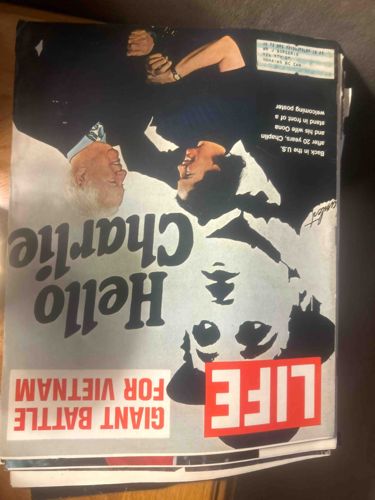
This item is a copy of LIFE Magazine, dated April 14, 1972, as discernible from the small text in the upper right corner, though the full date range is slightly obscured. The cover prominently features a black and white illustration of Charlie Chaplin's iconic 'tramp' character. Superimposed over this illustration are two photographs: one depicting an older gentleman with white hair smiling, and another showing a younger woman laughing, both appearing to be in conversation. Text on the cover reads "Hello Charlie" in large, stylized font, and smaller text indicates, "Back in the U.S. after 20 years, Chaplin and his wife Oona stand in front of a welcoming poster." Another important headline in a red box states, "GIANT BATTLE FOR VIETNAM." The 'LIFE' logo is in its characteristic red box in the lower right corner, rotated 90 degrees clockwise. The magazine appears to be made of standard paper and ink materials typical for periodicals of its era. Visible condition issues include some general wear and tear, slight curling or dog-earing at the corners, and potential discoloration due to age, consistent with a vintage paper product that has been handled. The spine shows some creasing, and the edges exhibit minor chipping. The overall aesthetic points to an early to mid-1970s publication, capturing significant socio-political and cultural events of the time. The quality is indicative of mass-produced periodicals, with print clarity and color saturation typical of its production methods.
AI Appraisal Report
Based on my visual examination of the provided image, this LIFE Magazine, April 14, 1972, featuring Charlie Chaplin on the cover, appears authentic as a mass-produced periodical from that era. The 'LIFE' logo, date format, and characteristic printing quality align with genuine issues.
Condition-wise, I observe signs of typical vintage paper wear. There is evident creasing on the spine, minor chipping at the edges, and some corner dog-earing and curling. Discoloration due to age is also apparent. While these are common for a magazine of this age, they do detract from its overall collectible value. The images show a copy that has been handled over the decades, suggesting it is in good to very good condition, but certainly not near mint.
Market conditions for vintage LIFE magazines are generally stable but do not command high prices unless the cover subject is exceptionally rare, historically significant, or the magazine is in pristine condition. Chaplin is a cultural icon, and his return to the U.S. after 20 years was a notable event, making this a desirable issue for collectors of cinema memorabilia or 1970s ephemera. However, LIFE magazines were mass-produced, so rarity is not a significant factor here; millions were printed. The headline about the "GIANT BATTLE FOR VIETNAM" adds another layer of historical context, which can appeal to some history collectors.
Comparable sales of similar condition LIFE magazines from the early 1970s, especially those featuring well-known figures, typically range from $10 to $35, with issues in excellent condition occasionally fetching slightly more. Given the visible wear, I would place this copy in the middle to lower end of that range.
Limitations for full authentication from an image alone include the inability to inspect the paper quality, ink vibrancy, presence of all original pages, and potential signs of repair or restoration. A physical inspection would allow me to check for complete page count, tears or missing pieces internally, and the true extent of discoloration or foxing. Provenance documentation would confirm its history, but for a widely distributed periodical like LIFE, this is rarely available or necessary for authentication, though it can enhance value if, for example, it belonged to a famous individual.