AI estimate as of August 19, 2025 · verify with a professional before acting
AI-Generated · Verify before acting
Everything on this page is generated by AI for informational purposes only. AI can make mistakes — the AI may misidentify items or misattribute them (artist, maker, brand, designer, origin, era). This is not an official valuation and should not be used for insurance, sale, tax, estate, legal, or lending purposes — or any decision requiring a certified appraisal. It is not an authoritative claim about any person, brand, or rights holder — do not share or rely on it as a factual statement about a third party. Always consult qualified professionals before making financial decisions.
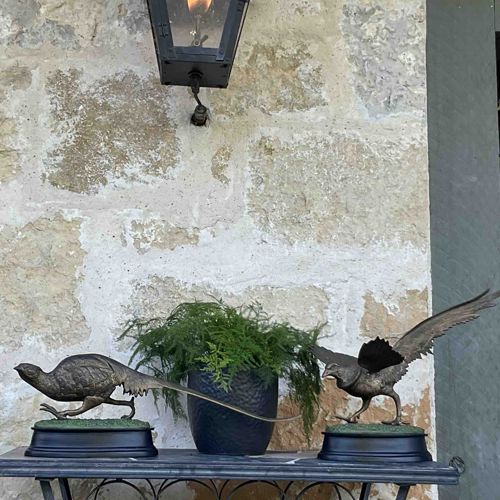
This item is a pair of bronze-patinated sculptures depicting pheasants. The sculptures appear to be cast, likely in brass or bronze, and finished with a dark, aged patina that gives them a rich, classic appearance. One sculpture portrays a pheasant in a running or scuttling pose, with its long tail feathers extending backward. The other sculpture captures a pheasant in mid-flight or about to take off, with its wings widely spread and mouth slightly agape, suggesting a squawk. Both birds are mounted on a simulated patch of green ground, which in turn rests on a stepped, rectangular black base. The bases appear to be made of a complementary dark material, possibly ebonized wood or patinated metal, providing stability and enhancing their display. The attention to detail in the feathers and musculature of the birds is notable, indicating quality craftsmanship. While no specific maker's marks or signatures are visible, the style suggests a traditional, possibly late 19th to mid-20th century European or American sporting art aesthetic. The patina appears consistent across both pieces, suggesting they are a matched set and have aged together. There are no obvious signs of damage, repairs, or significant wear, and the overall condition appears good, consistent with indoor display. The 'green' ground elements show some texture, mimicking grass. These sculptures are substantial in size, designed to be focal points perhaps on a mantelpiece, sideboard, or a console table, as seen in the image.
AI Appraisal Report
Based on my visual examination of the images, this pair of bronze-patinated pheasant sculptures appears to be in very good condition. The patina is consistent across both pieces, indicating they are a matched set which have aged together without significant handling or environmental damage. There are no visible chips, cracks, or repairs. The simulated green ground and black stepped bases also appear intact.
Authenticity, based solely on visual inspection, suggests these are period pieces, likely late 19th to mid-20th century, consistent with the sporting art aesthetic popular during that time. The detail in the feathers and musculature speaks to quality craftsmanship. While I can confirm the style is authentic to the period, I cannot definitively verify the material as true bronze versus a brass alloy without physical inspection or destructive testing. Similarly, without visible maker's marks or signatures, a definitive attribution to a specific sculptor or foundry is impossible.
Market conditions for decorative bronze animalia, particularly sporting themes, remain stable. Demand is moderate, primarily from collectors of traditional décor, hunting memorabilia, and wildlife art. Rarity for this specific subject in a matched pair and good condition is moderate; similar pieces appear occasionally at auction and specialized antique dealers. Factors impacting value positively include their matched nature, good condition, and substantial size. The primary limitation is the lack of a known artist or foundry.
For full authentication and to ascertain the exact alloy, a physical examination would be crucial. This would involve inspecting the underside of the bases for any obscured marks, checking for casting seams, examining the quality of the patination up close, and potentially conducting X-ray fluorescence (XRF) analysis to confirm metal composition. Provenance documentation, if available, would significantly enhance value by linking the pieces to a specific artist, period, or notable collection.