AI Appraisal Estimate

AI-generated estimates · not official valuations

From the user

What was submitted

Photo and notes provided by the user — not generated by AI

Submitted item photo
Submitted photo · May 27, 2026

User's notes

No additional notes provided.

AI analysis below

AI appraisal

AI analysis & estimate

AI-Generated · Verify before acting

Everything below is generated by AI for informational purposes only. AI can make mistakes — the AI may misidentify items or misattribute them (artist, maker, brand, designer, origin, era). This is not an official valuation and should not be used for insurance, sale, tax, estate, legal, or lending purposes — or any decision requiring a certified appraisal. It is not an authoritative claim about any person, brand, or rights holder — do not share or rely on it as a factual statement about a third party. Always consult qualified professionals before making financial decisions.

Read the full disclaimer

AI Identification

·Not independently authenticated·Verify before acting

Vintage-Style Floor Standing World Globe

Furniture and Home Decor / Cartographic Collectibles

AI Estimated Value

·Not an official valuation·Verify before acting

$150 - $250

As of May 27, 2026

AI Item Analysis

·AI can make mistakes·Verify before acting
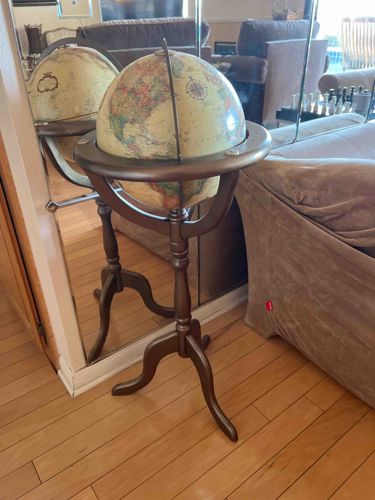
This item is a decorative floor-standing world globe featuring a vintage aesthetic. The globe itself is approximately 12 to 16 inches in diameter, printed with parchment-toned cartography that mimics early exploration maps, utilizing muted earth tones like ochre, sage green, and sepia. It is mounted within a traditional wooden yoke and a horizontal horizon ring, likely made of stained hardwood or a high-quality wood composite with a mahogany or walnut finish. The globe is supported by a slender, turned pedestal stand that transitions into a tripod base with three elegantly curved cabriole-style legs. Notable cartographic details include a classic compass rose and decorative illustrations within the oceans. The construction appears to be from the late 20th to early 21st century, designed as a decorative 'replica' piece rather than a scientific antique. The condition appears fair to good; there is a visible sheen suggesting a lacquer or plastic coating, with some minor scuffing possible on the wooden horizon ring. The stand shows no major structural damage, though the joints at the tripod base are typical points for minor wear or loosening over time. It lacks visible maker's marks from this angle, but the craftsmanship suggests a mass-produced high-end home decor item meant to evoke a colonial or federalist style.
AI Appraisal Report

·AI can make mistakes·Verify before acting
Based on my visual examination of this vintage-style floor-standing globe, I have determined it to be a high-quality decorative reproduction rather than a period antique. The parchment-toned cartography and muted palette are characteristic of late 20th-century home decor trends intended to simulate a 17th or 18th-century aesthetic. The construction features a stained wood tripod base and horizon ring; while the finish mimics mahogany, the uniform sheen suggests a modern lacquer application over a wood composite or secondary hardwood. The condition appears fair to good. I observed minor scuffing on the horizon ring and typical signs of wear at the base joints. Market demand for floor globes remains steady for traditional interior design, though value is limited by its status as a mass-produced item. Comparables found in estate auctions and high-end secondary markets typically fetch between $125 and $300 depending on the manufacturer (such as Replogle or Scan-Globe). A significant limitation of this appraisal is the inability to physically inspect the orb's material; a hollow plastic or fiberboard orb is standard for this era, whereas a plaster-coated orb would slightly increase value. Furthermore, I cannot verify the stability of the pedestal joint or the presence of a maker's mark underneath the horizon ring without a hands-on inspection. To fully authenticate this piece, I would require provenance documentation or a physical examination to check for hand-applied gores versus printed machine-applied paper. Given the visual evidence, it is valued as a functional decorative accessory rather than a cartographic collectible of historical significance.

Get your items appraised

Instant estimates of your treasures with AI-powered appraisals

Browse More Appraisals