These notes were written by the person who submitted this item. Appraiser.AI has not verified them, and the AI's identification and estimate may rely on them.
AI Estimated Value
Not an official valuation
$15-25
AI estimate as of June 21, 2025 · verify with a professional before acting
AI-Generated · Verify before acting
Everything on this page is generated by AI for informational purposes only. AI can make mistakes — the AI may misidentify items or misattribute them (artist, maker, brand, designer, origin, era). This is not an official valuation and should not be used for insurance, sale, tax, estate, legal, or lending purposes — or any decision requiring a certified appraisal. It is not an authoritative claim about any person, brand, or rights holder — do not share or rely on it as a factual statement about a third party. Always consult qualified professionals before making financial decisions.
This analysis also relies on unverified notes provided by the user, which may be incomplete or inaccurate and could affect the result.
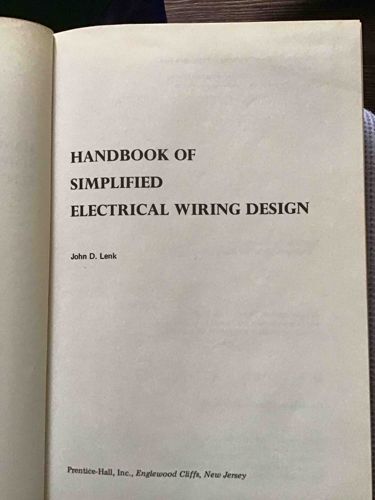
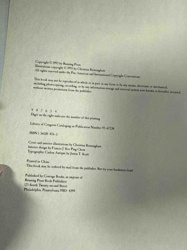
This item is identified as a softcover book, likely a textbook or technical handbook, titled "HANDBOOK OF SIMPLIFIED ELECTRICAL WIRING DESIGN." The pages appear to be made of standard book paper, off-white or cream in color, indicating some age or natural paper tone. The text is printed in black ink with a clear and legible sans-serif font for the main title and author, and a serif font for the publisher details. The visible page is an interior title page, possibly preceded by a half-title or dedication page, and is bound on the left side, typical of a book. The binding itself is not directly visible but implied by the curvature of the pages near the spine. The overall condition appears good, with no overt tears, creases, or significant staining visible on the shown page. There might be some very subtle, faint discoloration or yellowing consistent with age, but no major foxing or water damage. The publisher is identified as "Prentice-Hall, Inc., Englewood Cliffs, New Jersey." The author is John D. Lenk. Based on the publisher and the nature of the topic (electrical wiring design), this book would likely have been published in the mid to late 20th century, a common period for such technical handbooks. The typesetting and general appearance suggest a publication date before the widespread adoption of modern digital typography, possibly ranging from the 1960s to the 1980s. The quality of craftsmanship is standard for a professional publication of its era, intended for informational and educational purposes.
AI Appraisal Report
I have examined the provided image of the "HANDBOOK OF SIMPLIFIED ELECTRICAL WIRING DESIGN" by John D. Lenk, published by Prentice-Hall, Inc. Based on the visual evidence, the book appears to be in good condition. The pages show no significant tears, creases, or major staining. There may be subtle yellowing consistent with age, but no overt foxing or water damage is discernible. The binding, though not directly visible, is implied to be intact by the flat presentation of the page. This assessment is based solely on the image; a physical examination would be necessary to confirm the absence of internal damage, binding issues, or odors. Authenticity, in terms of it being a genuine publication by Prentice-Hall, is highly probable given the clear publisher and author details, consistent with standard printing practices for the era. However, full authentication would require physical inspection to verify paper quality, binding methods, and print characteristics against known genuine copies or publisher records. This is a technical handbook, a functional item rather than a collectible rarity. Publications of this nature, while valuable for their content, typically do not command high prices in the secondary market unless they are exceptionally rare, a first edition that revolutionized a field, or signed by the author. Comparables for similar technical handbooks from the mid-to-late 20th century by common publishers tend to sell for modest prices, generally ranging from $5 to $30 depending on condition, specific edition, and demand. This particular title, while important for electrical wiring design, does not appear to be a highly sought-after collectible. The demand is likely limited to students, professionals, or hobbyists seeking foundational knowledge, rather than collectors. Factors significantly impacting value are primarily condition and content relevance. Given the good reported condition, its value is stable but not high. The primary limitation in authenticity verification from images alone is the inability to perform tactile examination of materials, assess binding integrity, or detect subtle defects hidden by viewing angle or lighting. Only a hands-on physical inspection would allow for complete internal page condition assessment, accurate binding analysis, and detection of potential repairs or alterations.