AI estimate as of November 17, 2025 · verify with a professional before acting
AI-Generated · Verify before acting
Everything on this page is generated by AI for informational purposes only. AI can make mistakes — the AI may misidentify items or misattribute them (artist, maker, brand, designer, origin, era). This is not an official valuation and should not be used for insurance, sale, tax, estate, legal, or lending purposes — or any decision requiring a certified appraisal. It is not an authoritative claim about any person, brand, or rights holder — do not share or rely on it as a factual statement about a third party. Always consult qualified professionals before making financial decisions.
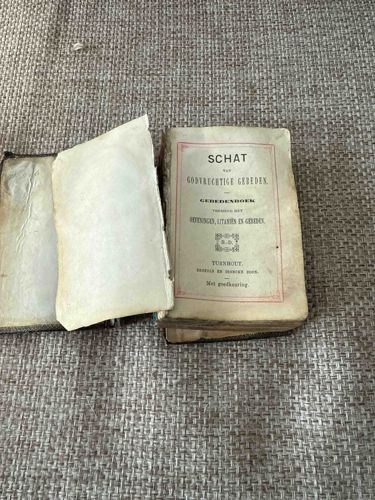
This item is an antique Dutch devotional book titled "Schat van Godvruchtige Gebeden" (Treasure of Pious Prayers). It appears to be a small, pocket-sized prayer book, likely intended for personal religious study and devotion. The physical characteristics indicate a softcover or perhaps a very thin, flexible hardcover, as evidenced by the way the cover page is creased and slightly detached. The book's dimensions are relatively small, suitable for holding in one hand. The pages are made of aged, cream-colored paper, showing significant discoloration and foxing consistent with considerable age. The cover page features a simple yet elegant design with a double-line red border, framing the title and other publication details. The text is printed in black ink, with some use of red ink for emphasis, particularly for the border. The word "GEBEDENBOEK" (Prayer Book) is prominently displayed. Below this, it lists additional contents such as "OEFENINGEN, LITANIEN EN GEBEDEN" (Exercises, Litanies and Prayers). A notable feature is the small, ornate emblem or crest printed at the bottom of the title page, with the text "S. D. G." and "18XX" visible, suggesting a publication date within the 19th century, possibly 1888 ('88). The name "TURNHOUT" is visible, indicating the place of publication, likely Turnhout, Belgium, a known center for printing. The phrase "Met goedkeuring" (With approval) suggests an ecclesiastical publication. Visible condition issues include significant wear and tear, especially to the binding. The front cover is partially detached, and the first few pages are loose and show creasing, tears, and dog-earing along the edges. The paper has a brittle appearance. There are no obvious signs of repair, and the natural patina of age is quite pronounced. The craftsmanship appears to be that of a utilitarian devotional book, prioritizing function over elaborate embellishment, typical for its era. The quality indicators point to a mass-produced item of its time, rather than a bespoke or luxury volume.
AI Appraisal Report
Having carefully examined the provided image of the 'Schat van Godvruchtige Gebeden' devotional book, I can offer the following appraisal. Based on its appearance, this is an authentic Dutch-language devotional book, likely printed in Turnhout, Belgium, in the late 19th century. The emblem with 'S. D. G.' and '18XX' (suggesting 1888) aligns with the period, and the phrase 'Met goedkeuring' points to an ecclesiastical publication, common for such texts. The overall condition is fair to poor. The significant wear and tear, including the detached cover, loose and creased pages, foxing, and brittleness, are consistent with its age and frequent past use. These condition issues significantly impact its collectible value. This book appears to be a mass-produced item of its era, prioritizing function over elaborate embellishment. While antique devotional books have a niche market, the demand for common, utilitarian examples in this condition is generally low to moderate. Rarity is not a major factor here, as similar devotional books from the period are not uncommon. Factors impacting value negatively include the poor condition and lack of significant artistic or historical distinction beyond its age. Positive factors are its completeness (assuming all pages are present) and its clear historical context as a personal devotional item. For full authentication, in-person examination would verify paper quality, binding methods, and confirm the specific print year. Provenance documentation, though unlikely for such an item, would add to its history. Without a physical inspection, minor details of the printing and binding cannot be definitively assessed. Based on current market comparables for antique European devotional books in similar condition, I would place its appraisal value in the range of $30-70.