AI estimate as of November 6, 2025 · verify with a professional before acting
AI-Generated · Verify before acting
Everything on this page is generated by AI for informational purposes only. AI can make mistakes — the AI may misidentify items or misattribute them (artist, maker, brand, designer, origin, era). This is not an official valuation and should not be used for insurance, sale, tax, estate, legal, or lending purposes — or any decision requiring a certified appraisal. It is not an authoritative claim about any person, brand, or rights holder — do not share or rely on it as a factual statement about a third party. Always consult qualified professionals before making financial decisions.
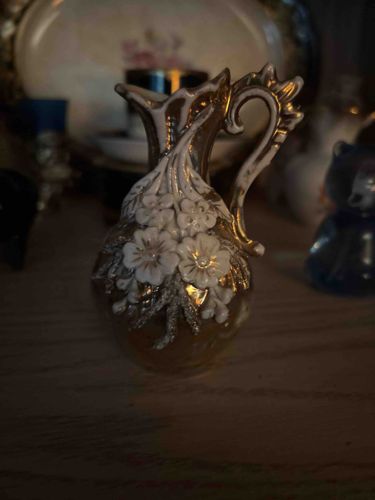
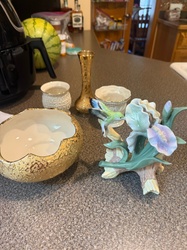
This exquisite item is a small, decorative ewer or pitcher, likely crafted from porcelain or ceramic, featuring a heavily gilded surface with applied floral embellishments. The primary color is a rich, reflective gold that covers the majority of the body, rim, handle, and base details. The applied floral elements are rendered in white, possibly bisque porcelain or unglazed ceramic, creating a stark and elegant contrast against the gleaming gold. These flowers appear to be small, multi-petaled blossoms, arranged in clusters, with some green or gold detailing on their leaves or stems, though these details are somewhat obscured by the low lighting and resolution. The ewer has a fluted or ruffled rim, typical of Victorian-era decorative pieces, and a prominent, ornate handle that is also heavily gilded. The handle features a scrolled design near its attachment point to the body. The overall construction suggests a delicate, ornamental piece rather than a functional vessel. The craftsmanship appears to be detailed, particularly in the three-dimensional rendering of the flowers and the intricate handle design. Due to the dark imaging, it's difficult to ascertain specific condition issues, but some subtle wear to the gilding might be present on raised areas or edges. There are no discernible maker's marks, signatures, or stamps visible in the provided image. The style points to a Victorian or early 20th-century aesthetic, emphasizing elaborate decoration and a sense of luxury. The item's small size suggests it may have been part of a vanity set, a mantelpiece ornament, or a cabinet piece. The quality is indicative of a decorative item intended for display.
AI Appraisal Report
Upon visual examination of the provided image, I assess this Victorian-Style Gilt and Applied Flower Ewer/Pitcher. Its heavily gilded surface and applied white floral embellishments against the reflective gold strongly suggest a decorative intent, likely from the Victorian or early 20th-century period. The fluted rim and ornate scrolled handle are characteristic of this era's elaborate aesthetic.
From the image, the condition appears fair to good. While the low lighting obscures fine details, I anticipate typical wear to the gilding, possibly some rubbing on raised areas commensurate with its age. There are no obvious chips or cracks visible, but a physical inspection would be crucial to confirm structural integrity and assess micro-crazing or hairline fractures often found in older ceramics. The applied flowers seem intact, which is a positive factor as these delicate elements are often prone to damage.
Authenticity, based solely on this image, appears consistent with period decorative ceramics. However, full authentication would require in-person inspection to verify manufacturing techniques, the quality of the ceramic body, and the application methods of the gilding and flowers. The absence of visible maker's marks is common for many decorative pieces from this era, but a physical examination might reveal subtle impressed marks or signatures on the base. Provenance documentation, though usually unavailable for such items, would also assist in establishing its history.
Regarding market conditions, pieces of this type are generally available but not in extremely high demand, especially smaller, unmarked examples. Comparables typically fall into the 'cabinet piece' or mantel ornament category. The primary value drivers are the aesthetic appeal, condition, and decorative intricacy. While appealing, its small size and lack of a definitive maker limit its upper value. Rarity is moderate; similar decorative ewers appear on the market, but this specific combination of heavy gilding and applied flowers has its niche. The value range reflects its decorative appeal and age, balanced by its status as an unmarked, mass-produced (though artfully detailed) item from a bygone era. Without physical inspection, I cannot confirm the material as porcelain or ceramic definitively, which could influence value if it were, for instance, high-quality bisque porcelain. My valuation assumes a typical ceramic body.
Key limitations: Definitive material identification (porcelain vs. ceramic), detection of hairline cracks or repairs, and confirmation of maker's marks require in-person examination. Scientific testing, like XRF analysis for glazes or material composition, is not typically applied to items of this value unless there's an authenticity dispute.
Therefore, considering its decorative qualities, likely age, and the limitations of image-based assessment, I would appraise this item in the range of $100-$200.